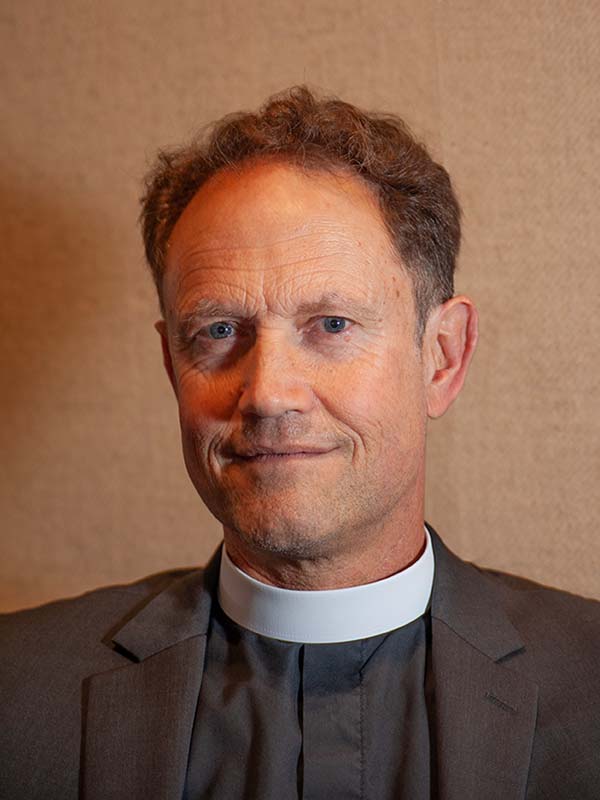

“It has taken me almost fifty years to understand fully that there is a necessary connection between God and architecture, and that this connection is, in part, empirically verifiable. Further, I have come to the view that the sacredness of the physical world—and the potential of the physical world for sacredness—provides a powerful and surprising path towards understanding the existence of God, whatever God may be, as a necessary part of the reality of the universe. If we approach certain empirical questions about architecture in a proper manner, we will come to see God.”[1]
Introduction
This paper explores affinities between UC Berkeley architect Christopher Alexander (1936-2022) and the puritan theologian Jonathan Edwards (1703-1758) using images from Alexanders’ books The Nature of Order. These two thinkers have similar notions about the sacred and the profane, and both oppose modern understandings of physical space as disenchanted. Although separated by two centuries and with no direct line of influence, they share a sensibility that beauty and the sacred are not individual subjective judgments conditioned by our cultural location but rather are qualities that inhere in objects and places. They agree that the sacredness of a place arises out of the relation between individual centers and the whole, in a relationship that they variously describe as life, harmony, excellency, and consent.
A Living World
The conventional wisdom in our society holds that a building’s quality is a matter of individual taste and not connected to our spirituality. It also assumes that these judgments, while shaped by various cultural influences, are essentially idiosyncratic and private. Some, following in the footsteps of Nietzsche and Foucault, may even suggest that judgments about beauty are a form of violence used to preserve oppressive social structures.
But what if every physical structure, every place or object, built or natural, had a kind of inherent quality so that some things simply have more life, or are objectively more whole than others? What if this built or discovered wholeness not only elevated or depressed our spirits but also formed an actual connection to the divine ground of reality?
Architect Christopher Alexander in his four-volume work The Nature of Order (NOO) offers exactly this challenge to the prevailing wisdom. In a world with millions of cubic yards of buildings and construction continuing on a massive global scale this question about the spiritual effect of objects in our world is crucial. Alexander’s claims flatly contradict postmodern aesthetics and our mechanistic assumptions about the material world. He has tried to reconcile a scientific worldview with his intuitive sense that creating living structure requires us to make things as a kind of gift to God.
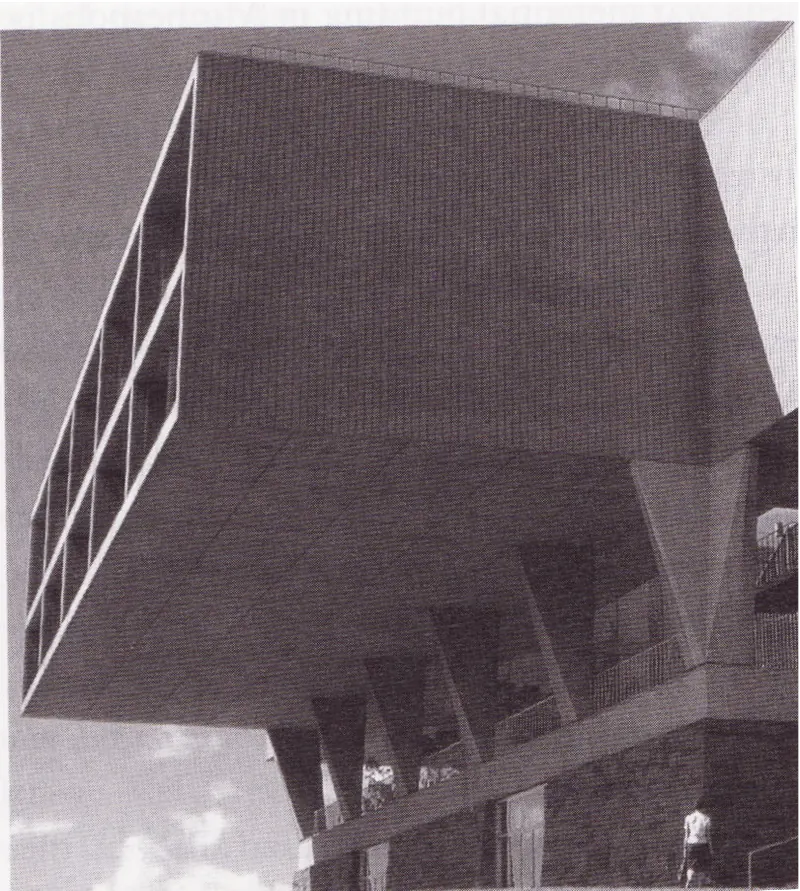
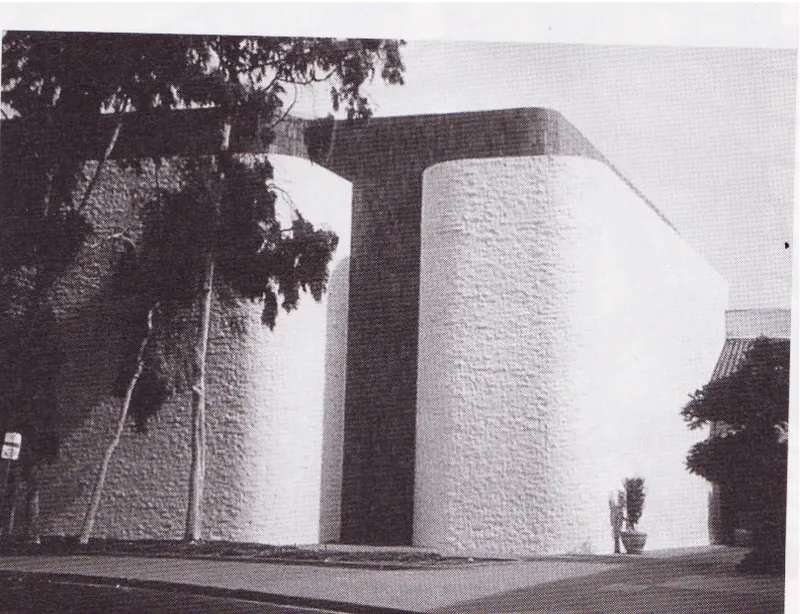
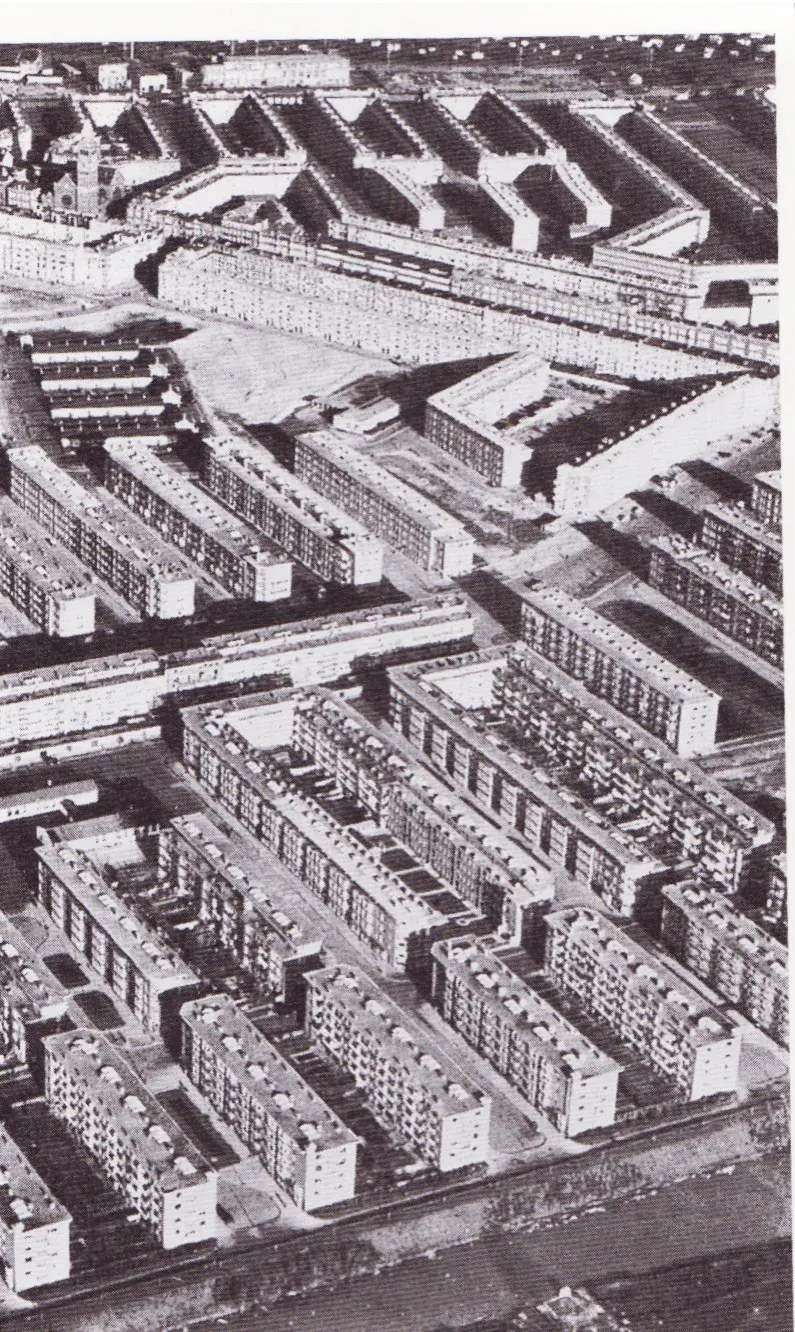
In the 1960’s and 1970’s Christopher Alexander and his colleagues introduced what they called “pattern languages.” These were simple rules that offered architectural guidance for decisions ranging in scale from regional planning (such as “mark the limits of the cities”) to the thickness of a house’s walls. They observed that modern architecture especially since World War II does not nurture people. The Milwaukee County War Memorial, this Southern California bank and the Amsterdam housing tract are examples of buildings that Alexander would argue are spiritually damaging to the people who have to live with them.
During this period architects built monstrosities that oppressed the human spirit in part because they felt more concerned about being recognized for their individual creativity than the usability of the building. They had also lost a sense for what is really beautiful. Alexander points out that the production of the environment was not in the hands of the people who actually live in it. He hoped that these pattern languages would democratically involve more people in creating their environment and provide them with practical tools for improving it and making it more coherent.
Over time Alexander realized that while using pattern languages did lead to improvements over modern and postmodern architecture, the results were still not necessarily what he called “profound.” Not all buildings constructed according to these rules had “life” or a wholeness which evokes deep feeling from people. Alexander studied this and designed experiments to objectively define what he meant by life.
The Mirror of the Self Test
The empirical tests were simple.
Researchers would show a large group of people two chairs or garden scenes or buildings or roads or doorways or sections of sidewalk, etc. Then they would ask, “which of these has more life, which makes you feel more whole or which is the image that best describes your true self?”
As one might expect people balked at the question. The researcher gently encouraged them to use their intuition. Alexander and his colleagues found that when people are forced to decide, there is between 80 and 90 percent agreement on which object or scene has more life. They claim that these results are remarkably consistent regardless of age, culture, race or nationality.
Alexander and his architects use this method to explore the experience of built and natural environments at vastly different scales. Some of these experiments seem to make sense; others may come close to stretching the limits of our credulity. Alexander reports that most people find that the street on the left has more life. Although some might claim that this is because there are more trees and bushes in that scene, what Alexander calls “life” is more complicated than the presence or absence of organic life. He illustrates this with the images below of two very similar stretches of road. According to Alexander the left-hand side has more life. The right hand side is “a little more stark, more brutal” “less harmoniously related to the hills” (NOO, 1:65).
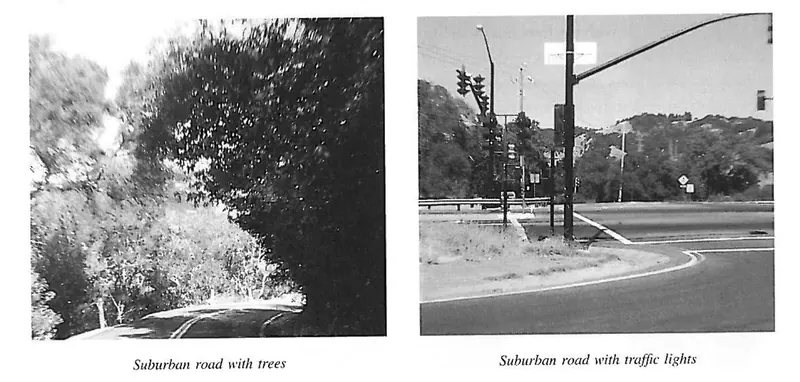

These experiments lead Alexander to conclude that, “What we call “life” is a general condition which exists, to some degree or other, in every part of space,” every moment and at every level of scale from the small amount of life in the period at the end of a sentence to all of Southern England whose connected communities together evoke deep feeling. Alexander claims, “that every part of space, small or large – has some degree of life, and that this degree of life is well defined, objectively existing, and measurable.” This life is universal, at some level all people recognize it, and at the same time it addresses each of us personally.
This does not mean that it is always easy to identify which object or scene has more life. Some objects are difficult to compare because they each contain a similar amount of life. In other cases, the objects seem too different to justify a comparison. It is also difficult because we are not accustomed to thinking about the way a scene moves us or evokes our feelings. Below is a picture of two different (overlapping areas) in a single bedroom. Which has more life?
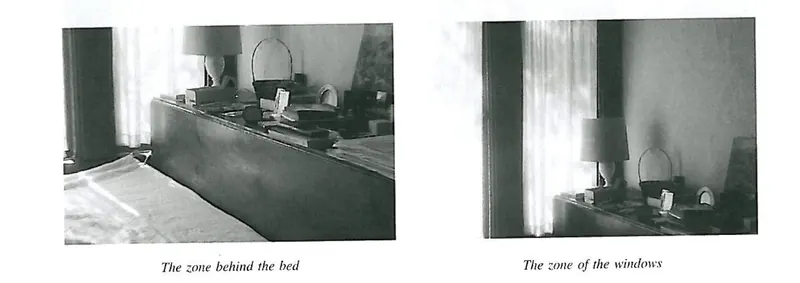
Alexander claims that the area behind the bed has more life (in the framing of this image), because it is better adapted to the use and the comfort of the people who live there. The two Berkeley parking lots below seem very similar. It may take some thought to experience one of them having more life than the other.
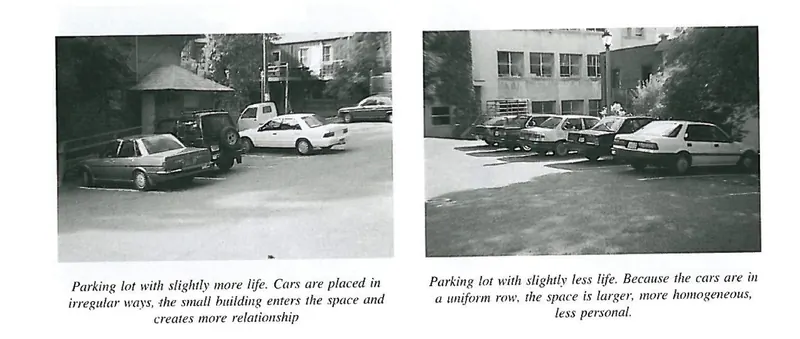
In this case Alexander claims that the left-hand side picture is more often chosen. He does not know if this is because the parking spaces are more irregular or the small building changes the scale of the relations in the image. In the pictures of the streets it seems relatively obvious which image has more life.
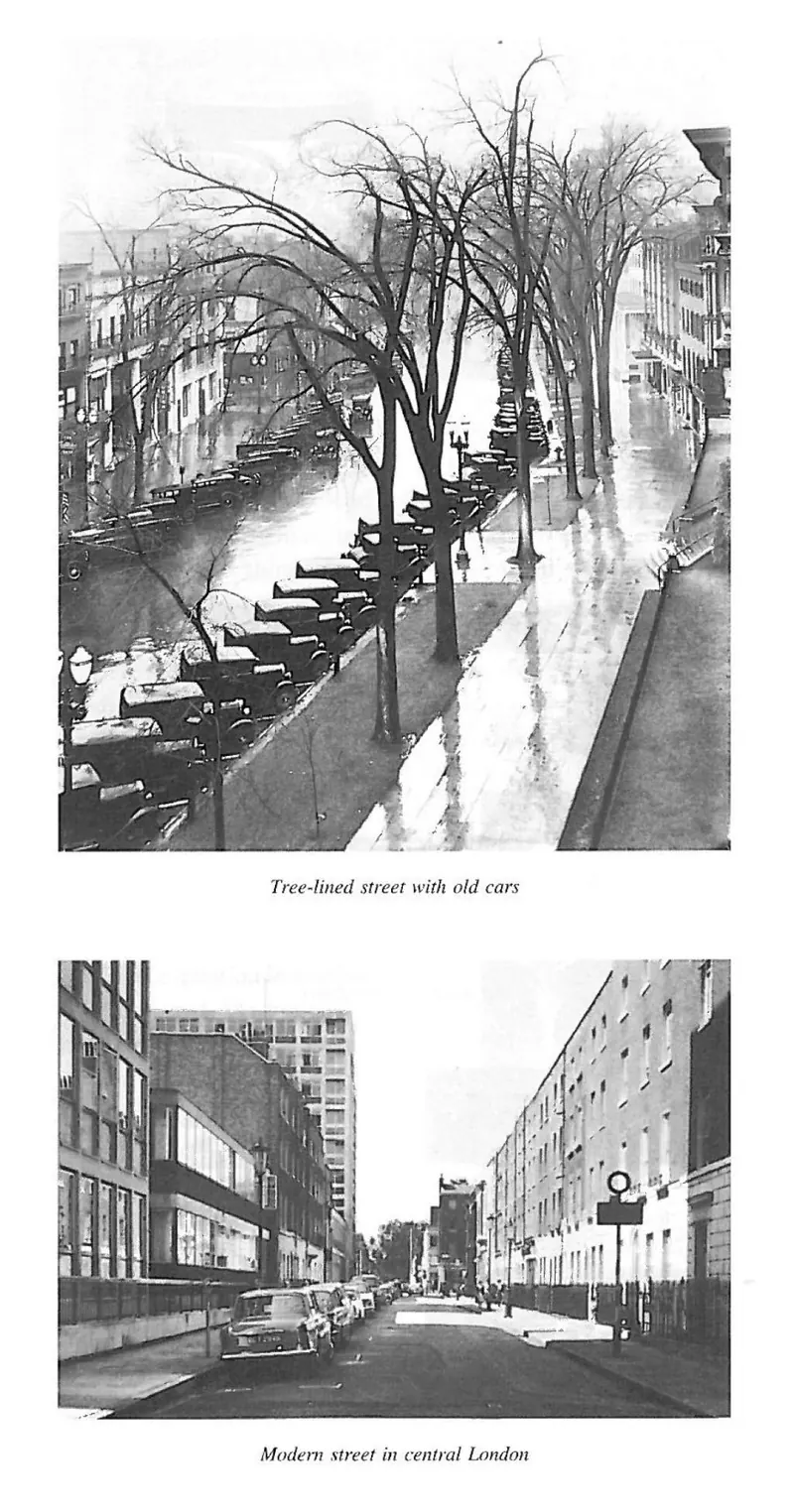
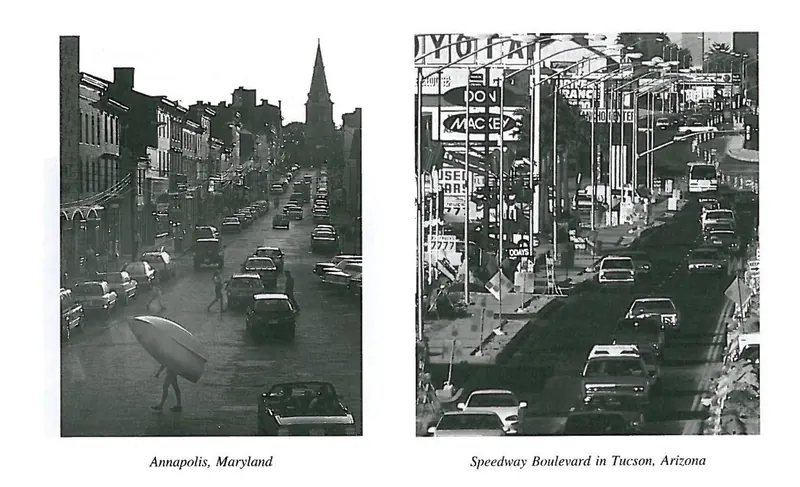
These are both busy streets. Alexander claims that in each case the first has more life than the second.
Alexander uses the mirror of the self test to compare art objects, prayer rugs, utensils, cups, an axe and a screwdriver, a can of rubber cement and a pair of scissors, even a dime and a nickel (the dime has more life). Look at the pictures below carefully and try this yourself. Which image “seems like a better picture of all of you… with all of your hopes, fears, weaknesses, glory and absurdity… which is more deeply connected to your eternal self” (Noo, 1:317)?
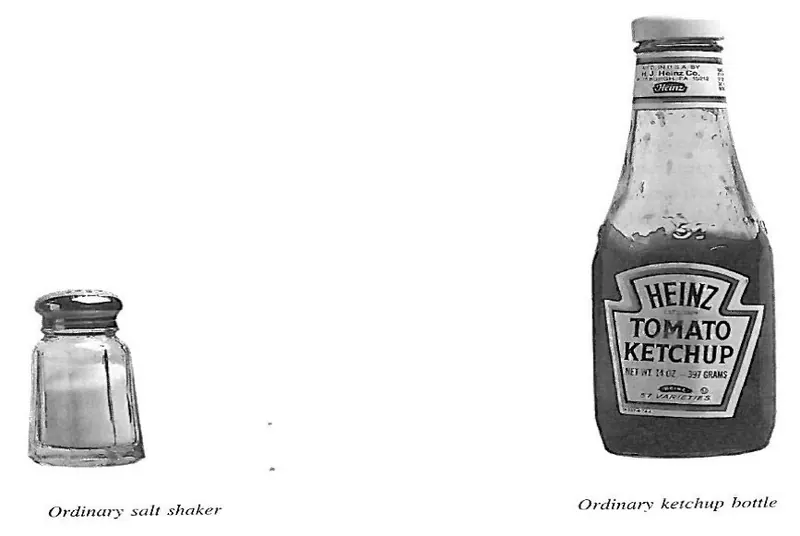
In this especially difficult case, Alexander claims that eighty percent of people choose the salt shaker regardless of age, gender or culture. This conclusion that life objectively inheres in all spaces fundamentally contradicts almost everything that I have been taught since college. For Alexander life is not in the eyes of the beholder but inheres in the world. Although this may be hard for a twenty-first century theologian to believe, the difficult task for a practicing architect who has this conviction is to discover guidelines that help us to understand how to build a world that has more life.
Fundamental Properties of Life
Using this method of evaluating two forms side-by-side with what he calls the “mirror of the self test,” Alexander identifies fifteen principles which seem to be correlated with buildings (and art) that particularly evoke the feeling which he associates with living structure. While the names of these principles do not mean much without a longer explanation I will list them here: levels of scale, strong centers, boundaries, alternating repetition, positive space, good shape, local symmetries, deep interlock and ambiguity, contrast, gradients, roughness, echoes, the void, simplicity and inner calm, and not-separatedness (NOO 1:144). In general these guidelines arise out of the way that the whole and the part create each other through what he calls centers. These regions in space attract our attention and are strengthened and weakened by other centers, by boundaries between centers, by shapes and scale, regularity of form, repetition, use of empty regions, etc. In short the fifteen principles provide practical guidance as an architect makes sequential decisions about a building’s form at every level of its scale from the way it strengthens other buildings in the neighborhood to the design of the interior doors.
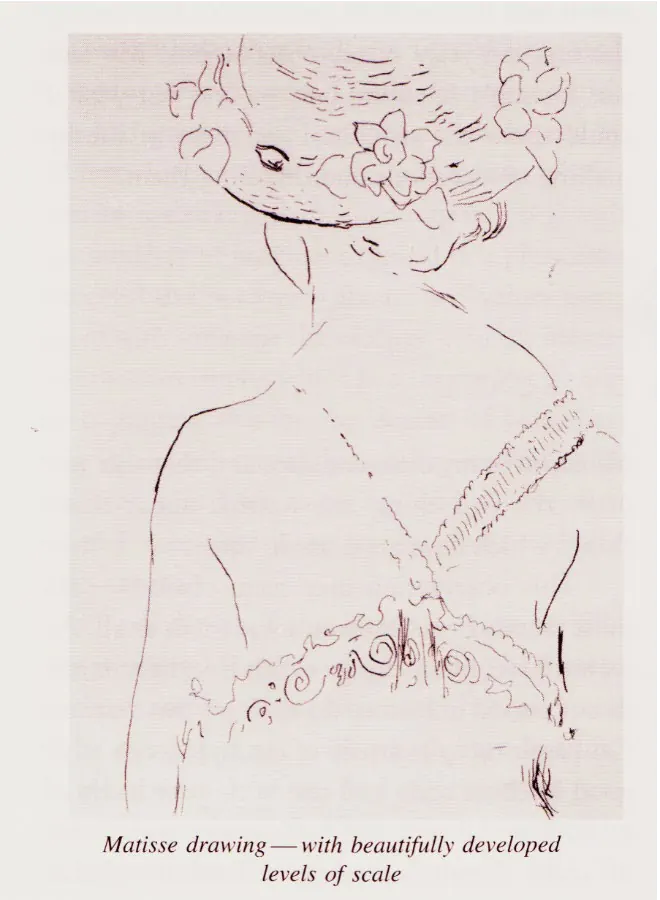
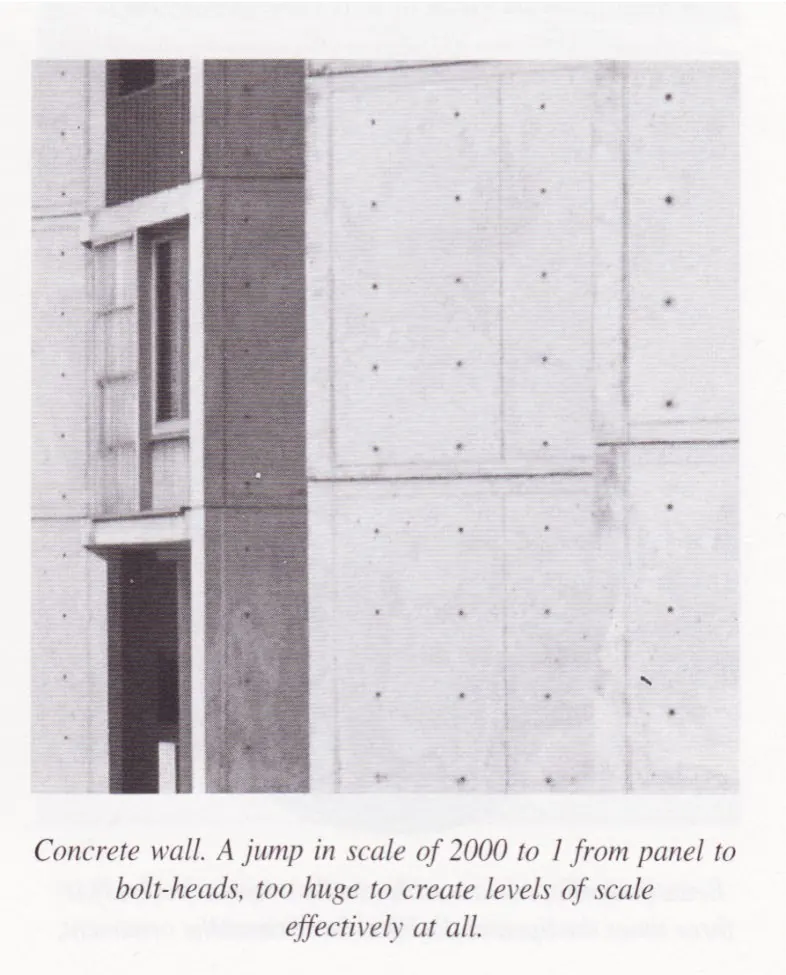
Although it does not make sense to try to explain every one of these principles, a deeper understanding of one of them may help to illuminate what Alexander is trying to accomplish. When Alexander first tried to articulate what makes an object have life, he noticed that centers of beautiful objects seem to have a definite range of sizes not just at the extremes of large and small but throughout. These do not occur randomly but have what he calls “definite jumps between them” (NOO, 1:145). There are small, middle-sized and large centers. He calls this quality “levels of scale” and illustrates it with the Matisse drawing above. The woman’s body is a center, there are centers formed by her back, head, hat, flowers and the petals, even the buttons and the lace are centers which all contribute to the whole. In contrast, Alexander writes about the exterior concrete wall shown below. Each panel is perhaps 36 inches by 72 inches. Each bolt is less than one square inch. The jump in scale from 2,000 square inches to 1 square inch is too extreme and seriously detracts from the life of this object. These principles are not limited to objects made by human beings.
We also see these same fifteen principles in nature not only in classical examples of beauty like the nautilus shell or a breaking ocean wave but in almost every natural phenomena. This includes the discharge of electricity in a field, cells, shells, cactus, flowers, electron orbitals, river deltas, muscle fibers, air turbulence, crystals and ferns. Natural objects often are symmetrical. They tend to be shaped by what he calls minimum energy and lease-action principles. For instance, a soap bubble has its shape because it minimizes potential energy due to surface tension. A tree’s branching pattern may be shaped by its effort to maximize its exposure to sunlight, while minimizing surface area or the distance between leaves and roots.

We recognize beauty in nature’s order, but Alexander goes further. He claims that almost every natural object exemplifies one or more of the fifteen principles, that each one has life. This is in stark contrast to objects made by human beings. People are uniquely capable of making objects that do not have life. Pre-modern, including what some might call primitive, city plans, buildings, and even art objects generally have more life. I will discuss three reasons for this below.
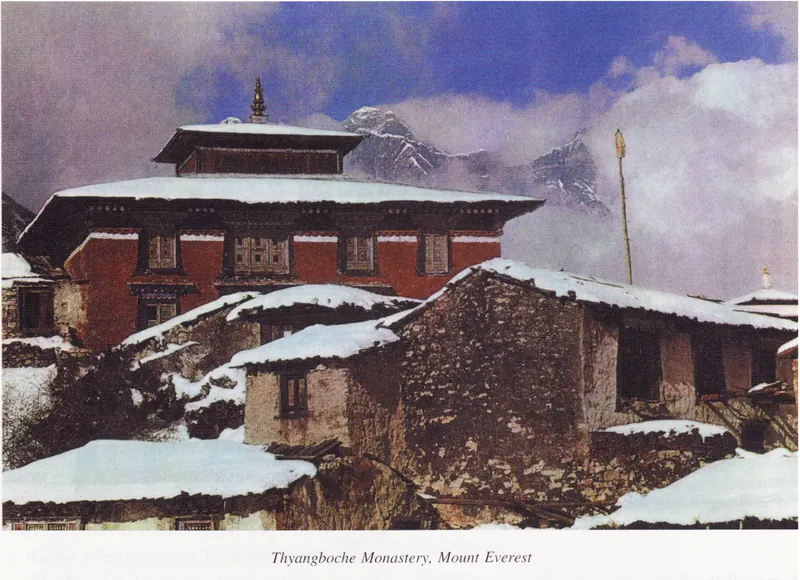
First, Alexander claims that objects made by people influenced by modern western philosophy are even less likely to have life. This is because the disposition of the maker matters – a person could see the world as alive spiritually (as deeply connected to him or herself) or in a disenchanted Cartesian way. This will influence what that person is capable of making. In other words, the mirror of the self test, used to understand life and the 15 principles which exemplify it, is also a central tool that architects need in order to build life. If someone creates things as what Alexander calls “a gift to God” those objects simply come out better than ones designed out of an egotistical need to be noticed, shocking, creative or new. Alexander does not quite put it like this, but a modern sense of individualism is part of what makes building beautiful things difficult.
Not only does the disposition of the builder matter, the process of making objects is also crucial to life. Alexander believes that well-ordered complex systems are generated not fabricated (NOO 2:181). Having an architect draw up blueprints and then having a separate group of builders bid on who can build the cheapest version of this imagined object is a process that makes creating life in buildings difficult. Life is most likely to come into being through an intentional, unfolding process rather than immediately out of someone’s imagination. He explains that a typical house has 2,000 man-hours of labor in it. There are 5,000 different decision points, many of which should be approached sequentially. For instance, you cannot know what the size and placement of the windows should be until you have put the foundation in place. The mirror of the self test needs to be applied at many different stages as the building takes place. It is not possible to foresee everything in advance. Because these decisions build on each other, a house with 5,000 decision points can have 20,000 mistakes in it, each of which objectively harms its deep structure. Although it may initially seem cheaper to use the conventional building process of blueprints and bids (what Alexander calls “image-driven process”), ultimately correcting these mistakes or living in a life-destroying environment makes this far more costly than using an unfolding process that is attuned to what Alexander calls “structure preserving decisions” (NOO 2:132).
A final reason why modern buildings are more likely to lack life comes from the overall context of their construction. Twentieth century building, like education, government, the military and other aspects of life, was deeply influenced by factory models of organization. Fordism and the culture of mass production deeply influenced what is built through the use of standardized materials. For instance, if window frames are only available in certain standard sizes this naturally inhibits an effort to match (in the words of the first principle) “levels of scale” in the rest of the room and building. Even building codes and the law in many ways can prove to be obstructions to building a living world. In summary, the disposition of the architect, the process of building from blueprints, the use of standardized parts (including the economics of building supplies, permitting, urban planning laws, etc.) all make modern built environments more oppressive to the human spirit.
The Theology of Christopher Alexander
Alexander does not have a religious or confessional agenda. In some important respects he feels ambivalent about the role that religion plays in the creation of living objects. But he does have a strong sense that what we believe deeply influences the quality of living centers. He probably would say that too often religion does not offer a viable alternative to the way that we usually see the world. This last section provides a short summary of Alexander’s picture of God and his description of what he calls “something very like a religious obligation to allow this self to reveal itself” (NOO 4:334). To offset the “meaningless and hopeless” worldview that predominates in our time, he feels concerned that we need a “coherent picture of the world in which spirituality or goodness make sense” (NOO, 4:18). Too many people speak and act as if the world were dead and inert. Even worse, the world we have been making over the last few decades, in contrast to what came before seems, “chilling, alien, distant… You feel frightened, disconnected, without heart. This is an unfriendly world. Little related to you…” (NOO 4:62).
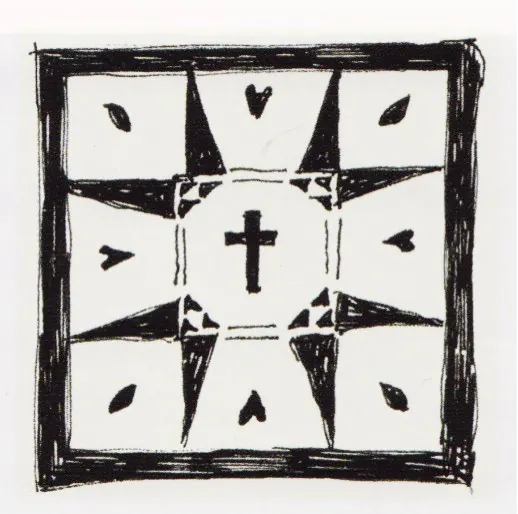
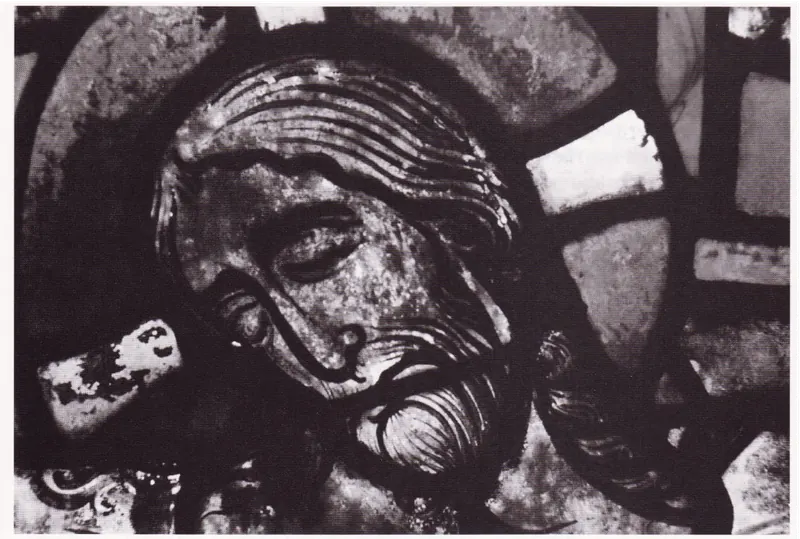
This is especially tragic because we have direct access to something else, something beautiful, alive and transformative which we “feel in the bones of the world, which comes out of the earth and makes our existence luminous” (NOO 4:2). In the centers of every beautiful natural or human made form there is a connection to the intimate, the personal, the “I” outside our self but connected to it. Matter is “soaked with self.” There is an interior element to the world that is humble, common, “enormous” which animates every living center. Our connection with this “Blazing One” matches our self; it is more visible in some things that others. It is like “seeing God” and makes us more human, more peaceful.
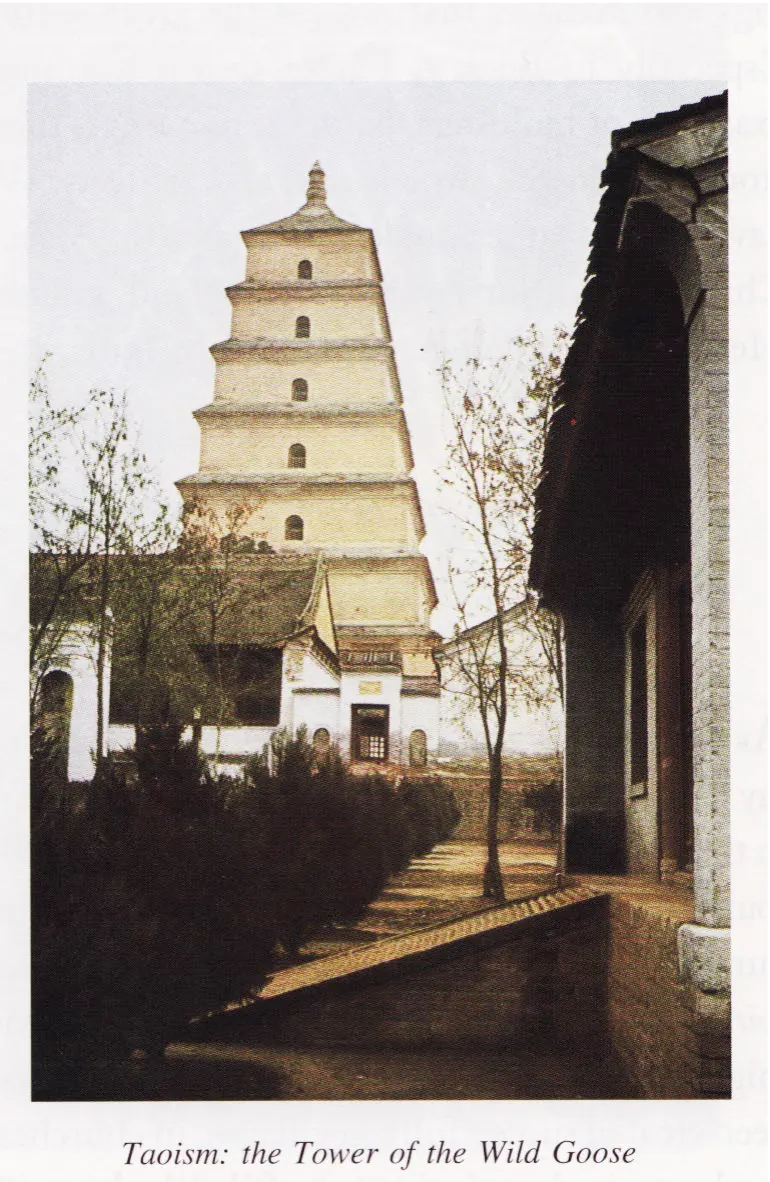
Another way that Alexander describes the personal nature of our experience is with a Buddhist account of the world as composed of 10,000 pictures of the self. In yet another image he speaks about the many centers we experience in living structures as tunnels for seeing the undifferentiated light, the “glorious unity” of God that always lies behind all things. We experience a kind of humility when we concentrate on this wholeness which grounds all things (NOO, 4:36). That is the reason why the “supreme examples of living structure” were created in a “mystical-religious context” (NOO, 4:31).
For Alexander perceiving and creating beautiful objects seem intimately related, and necessary for our nourishment. Making something beautiful creates a vivid experience of depth in our heart. To do this we have to cultivate humility and a kind of vulnerability, an “egoless state,” where we see things in a childlike way. Pleasing the deepest part of our self by making something in which God is visible gives us a clue that we are creating something profound. We overcome a kind of separation between ourselves and the blazing light when we manage to show God through the life which we contribute.
Jonathan Edwards’ Excellency
The world of Christopher Alexander and his ubiquitous mirror of the self test seems detached from the way we ordinarily look at things. Similarly, seeing the world from the perspective of the eighteenth century Puritan Jonathan Edwards (1703-1756) requires some effort. Although Edwards taught for a short time at Yale, he was internationally known as the author of David Brainerd’s biography and for his role in the Great Awakening. For most of his career he served as the pastor of a congregational church near the frontier in Northampton, Massachusetts. Ordinary people remember Edwards for his Enfield Sermon “Sinners in the Hands of an Angry God.” Theologians continue to study his work for a variety of reasons ranging from his analysis of religious experience, to his defense of predestination, and to his ethics and metaphysics.
Above all Edwards believed in the absolute sovereignty of God and that much of what appears to be human free will is merely the unfolding of deeply ingrained dispositions or habits that incline us toward or away from God. Like Alexander he proposes simple thought experiments which study harmony, proportion and equality to understand the nature of beauty and the mind. While Alexander studies hundreds of examples of what he calls life and deeply explores the particular qualities which evoke this sense of pleasure or harmony, Edwards is more interested in drawing broader conclusions from this experience.
Edwards also uses an idiosyncratic vocabulary to express his ideas. According to Edwards “excellency” (like Alexander’s life) is an objective goodness inhering to different degrees in the world. Edwards however emphasizes the way that excellency becomes intensified to the extent to which it is related to more and more of the universe, the whole, what Edwards calls “Being in general.” He writes, “That which is beautiful with respect to the university of things has a generally extended excellence and a true beauty.”[2] Something that is only beautiful alone or in connection to what Edwards in another context refers to as a “private system,” cannot really be that beautiful. Edwards explicitly claims that the extent of connections and relations matters for the presence of excellency.
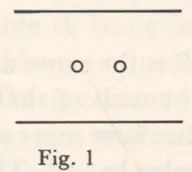
I want to briefly introduce several forms of excellency that Edwards describes using diagrams. In the beginning of his notes on “The Mind” Edwards writes, “There has nothing been more without a definition than excellency, although it be what we are more concerned with than anything else whatsoever. Yea, we are concerned with nothing else… Some have said that excellency is harmony, symmetry or proportion; but they have not yet explained it” (SPW, 332). At first excellency “seems to consist in equality.” If one of the dots in Fig. 1 were a little higher or of “a disproportionate magnitude,” or the lines were not parallel, it would be less excellent. The points would not be an equal distance from the lines that border them.
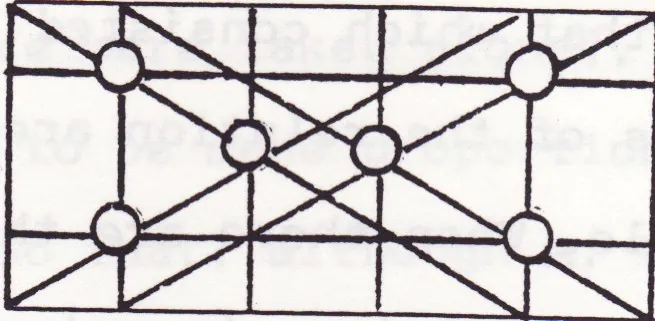
Edwards gradually increases the number of dots (and changes their configuration) in the diagram to show increasing equalities, until he uses Fig. 3 to explain a more complex form of beauty or excellence. In this case lines have been added to show how equalities can quickly multiply when only a few elements are added. The distance between the dots and the edges, the dots and each other, the distances along the perpendicular lines, etc., diagram an increasing number of connections between the edges, the dots and the whole. Edwards calls this simple beauty.
The next stage for Edwards is complex beauty which depends on proportion (rather than simple equality). He illustrates this using sequences of letters on a number line.
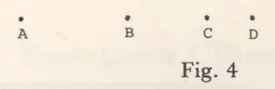
Edwards asks us to imagine in Fig. 4 that there are only the points A,B and C. If two inches separated AB and BC was equal to one inch, then if one were to add another point D it should be half an inch further to the right. This is because it would make the relation between CD and BC equal to the relation between BC and AB. He writes, “It is evident, this is a more complicated excellency than that which consisted in Equality, because the terms of the relation are more complex…” Again as with Alexander, Edwards is not merely claiming that he prefers this arrangement of dots or that it is simply more pleasing to the mind. There is something about it that simply exemplifies a greater degree of excellency. In fact something that may seem marred or ugly in one narrowly construed picture may be exactly what leads to a greater proportion on a higher scale. Edwards uses the example of musical harmonies to think about how a dissonance can contribute to a greater beauty.

Like Alexander, Edwards sees these principles as the source for our delight in nature. He does not merely refer to static beauty. Edwards also recognizes the beauty of harmonious motion.
“[W]hat is called correspondency, symmetry, regularity and the like, may be resolved into equalities; though the equalities in a beauty in any degree complicated are so numerous that it would be a most tedious piece of work to enumerate them. There are millions of these equalities. Of these consist the beautiful shape of flowers, the beauty of the body of man and of the bodies of other animals. That sort of beauty which is called “natural,” as of vines, plants, trees, etc., consists of a very complicated harmony; and all the natural motions and tendencies and figures of bodies in the universe are done according to proportion, and therein is their beauty… the quantity of equality is not to be measured only by the number, but the intenseness, according to the quantity of being” (SPW, 335).
Of course, Edwards’ goal is not to make more beautiful buildings and so at this point his project begins to diverge sharply from the work of Christopher Alexander. Edwards does not come up with fifteen principles for arranging dots and lines in a pleasing way, but he does also appreciate the way nature seems to exemplify excellency through equality and proportion.
Being and Consent
Proportion is a more intense form of excellency than equality. Edwards then extends his study of excellency into the social realm. For him consent, that is the harmonious relations between intelligent beings, is an even stronger form of excellency. “Spiritual harmonies are of vastly larger extent: i.e. the proportions are vastly oftener redoubled, and respect more beings, and require a vastly larger view to comprehend them…” (SPW, 336). He goes on to conclude, “This is an universal definition of excellency: The consent of being to being… The more the consent is, and the more extensive, the greater the excellency” (SPW, 336). The quality and extent of relations are the source of what Alexander calls “life” and what Edwards describes as excellency. God is the one being who exhibits the greatest excellency through harmonious connections to everything in the universe.

I think that Christopher Alexander would say that God is the luminous ground beneath all things. We get epiphanic glimpses of God through the strong centers where “life” is most evident. Our purpose is to have a kind of mystical experience of God and to create a world in which more of God shines through. According to Edwards God is a much more necessary and relational being. The relationships among created beings matter for God and in turn magnify the excellence of the universe.
Following in the footsteps of Henry More (1614-1687) and Isaac Newton (1642-1727) Edwards does not define being as extension but in terms of relations. God is not primarily the creator, but the sustainer, the one upon whom everything in creation depends in every instant. In his essay “Of Being” Edwards writes that “[t]he mind can never… conceive of a state of perfect nothing” (SPW, 202). All of our thoughts presume a spatial context. “Space is this necessary, eternal, infinite and omnipresent being… space is God” (SPW, 203). Some modern physicists describe physical objects as clouds of particles. This is not far from Edwards’ picture of fundamental reality as a matter more of energy (like that which holds together subatomic particles) than of substance or extension. Physical beings are not so much solid things as conglomerations of points in space that through God’s power resist annihilation. So relation is not something that is added on externally to already existing things. Relation to God constitutes all things. Relation lies at the heart of all existence and excellence describes the most harmonious and extensive relations that we experience. Even God seems related and magnified by the internal relations of the trinity (and through external connections to creation itself). Even God is not alone. “One alone, without reference to any more, cannot be excellent; for in such case, there can be no manner of relation… and therefore no such thing as consent… In a being that is absolutely without any plurality there cannot be excellency, for there can be no such thing as consent or agreement” (SPW, 337).
The simple examples of beauty and excellency that we see in equality and proportion are images for us of the more intense excellency that we experience in our relationships to other people and to God.
“One of the highest excellencies is love. As nothing else has a proper being but spirits, and as bodies are but the shadow of being, therefore the consent of bodies to one another, and the harmony that is among them, is but the shadow of excellency. The highest excellency, therefore, must be the consent of spirits one to another. But the consent of spirits consists half in their mutual love to another, and the sweet harmony between the various parts of the universe is only an image of mutual love” (SPW, 337-8)
So excellency is not merely concerned with sense perception or of harmonies that we see in physical objects. It is an ethical matter. In his treatise The Nature of True Virtue, Edwards contrasts the kind of virtue which leads to sacrifice for the sake of “private systems” (such as our allegiance to self, family, community, nation, etc.) with true virtue as a responsibility to the whole, to all being. He makes the point that only God is capable of true virtue. At the same time however, human beings are capable of greater or lesser degrees of true virtue depending on the extent of our commitments. We can imitate God in the breadth of our love for others and the whole.
For Edwards “[t]ruth is the perception of the relations there are between ideas” (SPW, 340) so that the good, the true and the beautiful can all be understood as examples of excellency, that is harmonious relations in a world ordered and sustained by God. Physics, nature, art, ethics, and religion are not separate departments of existence but rather are mutually confirming experiences of God’s grace. Edwards sees aesthetics, ethics and epistemology as different manifestations of excellency.
Conclusion
Although both Alexander and Edwards use diagrams and thought experiments to describe beauty and assert that there is a kind of sacredness unevenly present and inherent in nature, one might ask, “What is the point in studying side by side an eighteenth century puritan frontier minister and a twentieth century California architect, two thinkers whose basic worldviews in almost every way diverge?” I propose three related reasons.
First, especially in our contemporary situation, we need to work toward (in Alexanders’ words) “a coherent picture of the world in which spirituality and beauty,” and for that matter harmony, goodness and kindness “make sense” (NOO, 4:18). This is true not only for our own spiritual edification, but so that we can better understand our world and the implications of our actions. Treating the world as mostly inert or dead matter has devastating consequences not only to the earth, but also to the lonely human beings who fail to recognize their connection to this living world. The modern picture of disenchanted nature leaves too much of the world outside the bounds of our ethical awareness and even cuts us off from other cultures and generations of people who better understand what it means to be connected to “life” or God’s “excellency.”
Second, in a world of massive construction projects, the destruction of nature, and ongoing inhumanity, we need to have this orientation to the world because we have responsibility to “life” to the “excellency” that is magnified through harmonious relations between physical objects and spiritual beings. We need to be conscious that what we build and create (including the institutions of modern capitalism) can be deadening to spiritual life. Recognizing life as an unfolding process that requires personal humility is the first step toward creating a context and institutions that are more likely to nurture the human spirit. Everything we make, all the relationships we cultivate, should be a kind of gift to God in the same way that Alexander recounts the ecstatic experience of creating something that is saturated with life.
Finally, these thinkers help us to recognize the importance of beauty, not as an afterthought or a means to some other end, but as a deep part of every being’s life. They help us to be conscious of the gifts that the world constantly offers and they prepare us to receive this grace. Both Alexander and Edwards remind us that ornament and function are not separate hierarchically arranged aims. Our life, in the work we do, in our relations to others, should be primarily about beauty and consent. More than this they remind us of the fundamental goodness of creation and even of our own beauty. We are architects of our life, using the mirror of the self test to expand goodness in the world. We choose whether we will be dedicated to small private systems of concern or have a responsibility to the whole and to God as beings consenting to Being.
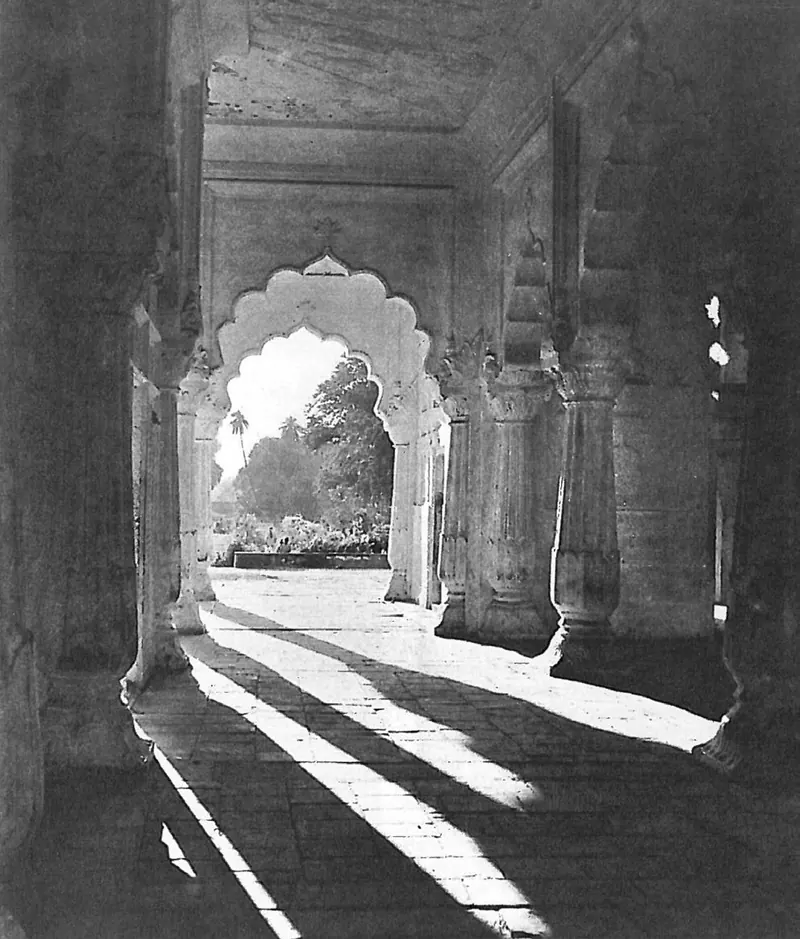
“Only in the last twenty years has my understanding of this connection taken a definite form, and it continues to develop every day. It has led me to experience explicit visions of God, and to understand, in some very small measure, what kind of entity God may be. It has also given me a way of talking about the divine in concrete, physical terms that everybody can understand.”
Christopher Alexander, “Making the Garden”[3]
Christopher Alexander, “Making the Garden,” First Things, 1 February 2016 ↩︎
The sources I am using for this mostly come from Edwards’ scientific writings (SPW) especially, “Of Being,” “Of Atoms,” and “The Mind.” His sermon “The Excellency of Christ” might also be helpful for understanding what he means by this term. Jonathan Edwards, “The Mind” and Related Papers,” The Scientific and Philosophical Writings. Ed. Wallace E. Anderson (New Haven: Yale University Press, 1980), 356. ↩︎
Christopher Alexander, “Making the Garden,” First Things, 1 February 2016. https://firstthings.com/making-the-garden/ ↩︎
© 2025 Malcolm Young, Th.D. All rights reserved.