

FOREWORD
I must start with our new vocabulary problem. Aristotle famously accounted for the existence of homonyms – words like “organ” – by saying there are fewer words than things. I want to propose that one such word is “man.” In its first meaning it is used, as in the current translation of Genesis 1:27, for the male of the human species; but it can be used for a second entity, a very special entity, the one entity in the world that is conscious of being a social and political animal but also wonders where it came from. Men are not the only “men,” but women are “men,” in this second sense, also. On the history of the usage I append a page from Volume 6 of the OED, sub voce MAN.
At the same time that we are finally paying due attention to this, and perhaps for the same reasons, we are losing unanimity on a socially relevant scale as to the true essence of the entity denoted by this second sense of the homonym. In other words we are on the verge of believing that all there are is men and women.
Thinking as I do that the entity and the concept denoted by the second homonym is of utmost importance for us, and recognizing that we do not have a word for it because we do not agree on its essence, I propose that until we do, we continue using the homonymous term in its second denotation, but adopt a covenant to add air quotes when using it in the second sense, and employ this gesture sedulously as a constant reminder of the centuries we have taken the homonymity for granted, a small reparative gesture on the order of the temple garment worn by Mormon priests.
I will be using the term in its second sense tonight since my theme, inspired by Peter’s essay on Nostalgia and Memory last session, is that the dilemma and anxieties and vicissitudes this “man” suffers, the one who finds “himself” both in society and under God at the same time, can very fruitfully be explored, articulated, mediated, and even healed by the gifts of the goddess Mnemosune: Memory, the mother of all the Muses – and in tonight’s special case, the Muse of music itself.
Nuremberg, Salzburg, and River City
The advent of Donald Trump and his policies in this his second term have raised such anxieties and dilemmas all through the world. We all feel them in our several ways, and this fact has become more and more a distraction for me since the Inauguration: in the same way we say of some friend that he “happens to be Jewish” or another that he “happens to be a black,” I happen to be a supporter of those policies, and therefore, by default and along with a strong dose of guilt by association, a supporter of the man who embodies them in a way that scares even me.
Among the distractions are my communications by email and blog with friends in Europe who are almost universally beside themselves with scorn and opposition, and call for me to explain how I could support him, if I mention that I do. It has been taking about the same amount of time, at the same time of day, as Morning Prayer used to, since they are ahead of us by nine hours. Most of my friends in Old Europe have lost patience with me, with the exception of a gentleman from Munich I’ve known for thirty years, who studied with one of my teachers in the 70’s, and after several email exchanges has now decided I am a “great man of dialogue,” thanking me for continuing to answer his “provocative questions” so patiently.
I will not omit to say that he, a good Roman Catholic, wrote those kind words to me on Good Friday.
As I said I had planned to follow up on last month’s theme of Memory, but in between I made my yearly visit to what I call “my authors” in France, Germany, Austria, and the UK. Politics continued to be raised in every meeting, particularly their questions about Trump and my questions about the German election, all this to be expected. But while still in Paris – indeed sitting in my seat at the Bastille waiting for the second act of Don Carlos – I had the sudden shock of reading in an email from the Plato man at the Free University of Berlin, whom I was on my way to visit next, that he could no longer take seriously my ideas on Plato, given the fact that I support Trump! This was a new kind of surprise, since he and I have been having close and technical conversations for fifteen years on that favorite author of ours; as it turned out we seemed to have a very productive meeting for over ten hours – politics did not come up. I can say however that the high point of the trip came the next day, and to learn from another friend who came to visit me in Berlin the motto, Respondeo etsi mutabor: “I will answer even if it will change me!” – a motto of the hugely unknown Eugen Rosenstock-Huessy, who in saying it is saying that while many of us are satisfied to say what we can – what are qualified to say – times come when we say what we must, duty bound to respond, regardless of the outcome.
In the aftermath of the trip I had to think anew about American and European culture; and in particular I wanted to find some “song to sing” about the problem, rather than continuing to deal in the toxic and vitriolic back-and-forth. It has been my experience over my lifetime that beautiful and inspired music can magically make even something we had thought bad seem good. Just so I regret that, recently, several great musicians have either been banned from the stage in the US or have themselves cancelled concerts here because of their political beliefs: maybe their musical gifts are just the balm we need.
*
Looking over to “Old Europe,” we see in contemporary museology, in art and its curation, and particularly in the new movement of “Regietheatre” in opera, symptoms of a highly unenviable cultural crisis. The German term “Regietheatre” is a neutral term – “Director’s Theatre” – but in America we call a spade a spade and call it Eurotrash. The neutral term was adopted there, to normalize a director’s prerogative to transmogrify the original plot of an opera – characteristically a nineteenth century work – with an overlay of twentieth century political themes. The last Meistersinger I saw at Bayreuth, for instance, was staged in the courtroom of the Nuremberg trials; and the Parsifal took place in Palestine. This willful confusion of things is distinctly European and it is due, I think, to the multilayered, paradoxical, and even self-contradictory elements constituting the cultural memory of Old Europe. Central still is the phenomenon of the Nazis; deeper is the centuries old, fundamental, bloody, irreconcilable breach between the Christians on the continent, with its hundred and thirty years of war; and at present the European culture is being tasked to digest the effects of mass migration, which are saliently visible but so far show little sign of integration.
This theatrical movement is tolerated by the elites, who continue to attend and support opera: In their clouded and compromised conscience they accept the scolding reminders as deserved wrist-slapping, like a weekly confession but assuredly without the outcome of atonement; and at the same time they miss no opportunity over drinks afterward to decry the scolding Directors as bratty children. By comparison, I would say, we Americans are living lives of dreamy children, and this is central to my theme.
Now I wish to observe that the Regietheatre never touches the music! This, I am sure, the audience would never tolerate: the music, the voices, the orchestra is the thing. And so I reiterate my theme: the awesome power of music to make everything right, or at least tolerable. These are the ideas in the background of my essay tonight: Nuremberg, Salzburg, River City.
It was in 1862 that Richard Wagner completed the composition of his Meistersingers of Nuremberg. Exactly 100 years later, in 1962, two movies came out in the US that likewise prove the power of music to soothe and settle and even redeem many of the troubles and foibles we suffer as “men”: it even penetrates and mediates our lives of worship and prayer, the way Dean Young’s essay earlier this year proved that visual beauty can. After all, The Sound of Music, though written in America, takes place in Roman Catholic Austria, emphatically so; and Wagner’s Meistersingers takes place, on St. John’s Day, in a very Lutheran Nuremberg. Both of these stories rely heavily upon and incorporate those ways of worship in their plots, and the difference between these ways are much of what makes the plays different. Maria’s life was really an extension of her service within the Convent; and as I will show you Wagner turns the Lutheran Hans Sachs into a Wagnerian hero.
*
The Meistersinger opens at church during the closing hymn, a Lutheran hymn about Johannes der Vorlaufer, John the Forerunner, with some young nobleman pacing back and forth in the vestibule, trying to attract the attention of a young lady seated in the pews. Immediately we recognize the ambivalent attitude of the great Zauberer, the musical magician, Wagner, who in his egoistic way is always needling Christianity. His Catholic friend Franz Liszt famously persuaded him to abandon his project of an opera on Jesus of Nazereth. In every case Christianity does come up as an explicit theme (Tannhauser, Meistersingers, Parsifal: only implicitly so in Lohengrin), his depiction of the Gospel story imposes distortion, on the one hand due to his attenuated but Nietzschean envy of Jesus, and on the other by his ardently embraced certainties about human sexual psychology (Kundry, of course, in Parsifal). Of these distortions, however, the least guilty among his works is the Meistersingers, for the good reason that in this case our brilliant egomaniac did not have to identify with the heroes of the Medieval legends (Tristan, Lohengrin, Parsifal) but with a realer hero, and a hero more akin to himself despite being a shoemaker, an historical man: the great Hans Sachs of Nuremberg. Even today there’s a statue of him in the square.
I myself would crave to be among a group of “men” from all the trades, who gather in an orderly way on Sunday afternoons to discuss Song, to formulate and promote and preserve its rules – as the Mastersingers gather and do in Wagner’s Act One – It is not that far a cry from our Club in its best form! And I am brought to tears just to think of a city in which the general populace could invest their pride and self-definition in the artwork of such a guild, on the banner of which is depicted King David with his harp. In the present case, after its well-known and stately prelude, we meet the goldsmith Pogner, the richest of the group, announcing to the guild that “to the winner of this year’s song contest, tomorrow, held as always on Johannestag, in the meadow by the Pegnitz, I will give the hand of – Eva, my only child, in marriage! To complicate matters the Mastersingers narrowly adopt the exceptional provision that this year the contest will be adjudicated by public acclaim, for as their most respected member, Hans Sachs, argues, it is well that from time to time their puristic enclave should test whether its ideas have anything to do with what is happening in the real world. That was quite enough for a plot, but in addition Wagner adds that a new man came to town yesterday: Walther, a knight and a singer from a different school, who has already fallen in love with the same goldsmith’s daughter – so that in order even to compete for her hand he must become a Meistersinger in one day!
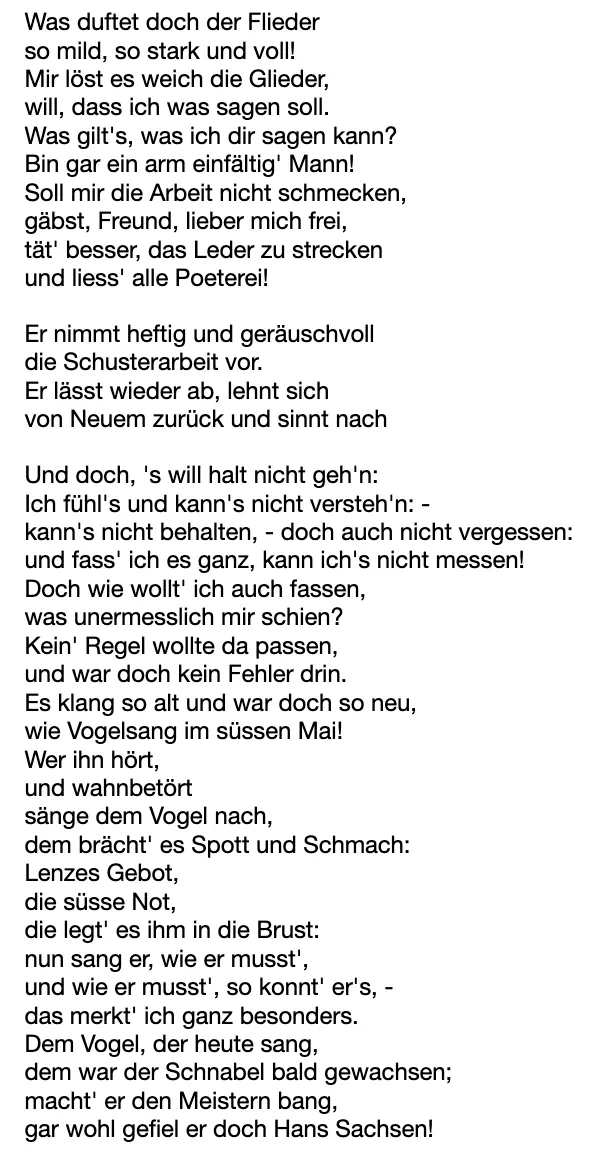
The masters use their session to test his mettle, and his trial-song is inspired but strange to their rules: it causes a scandal among them, and the Act ends in chaos. But one of them – our Hans Sachs – is enchanted. Later that evening, at the beginning of Act Two, under the lilac-tree outside his shop, he sings this song (please follow the words, notice how his individual conscience is his humble guide, and note the modalities of can and must):
Wie duftet doch der Flieder (6 min, text appended below)
The next morning Sachs contrives to teach mastersong to Walther in his shop. Again I am brought to tears, by the way that Sachs avers and proves that artistic inspiration comes not just from unrelenting study but from the love of life – I hope you had a taste of that attitude in the song we just heard him sing, and note it is an entirely Protestant sort of thing to subject the rules to private inspiration, something like the sola fidei: this is Wagner’s use for the Lutheran setting! But at the same time he and Sachs are defining artistic creativity. Walther has had a beautiful dream and fears he will forget it; Sachs tells him the whole reason for song is to capture the truth of dreams – and Walther succeeds to sing it! He imagines Eva in the Garden of Eden. Next, a Mastersong song must have a second stanza – because there are two of you! – and there it is, Eva the Muse of Parnassus! And then there must be an Aftersong because your love will produce a child, but now Walther tires of the unstinting rigors and vulnerability of having to say nor only what he can say but must say — and he wants a break. They adjourn their work to dress for the festival, but soon Eva shows up to get her shoes adjusted, expressing her fears Walther will not win. At this point we have a choice bit of Wagner’s roaming sexual imagination, with Sachs leaning down to fit the shoe to her foot, while (in a good staging at least!) Eva looks over his head to see Walther enter the room behind him and music explodes from the orchestra – She is in love with him and he with her, and Sachs devolves into nothing but a shoemaker; but then – a special moment for any man who has a daughter – Eva upbraids him, confessing that he has all along in her life been her “Wakener” – without him she would be but a girl.
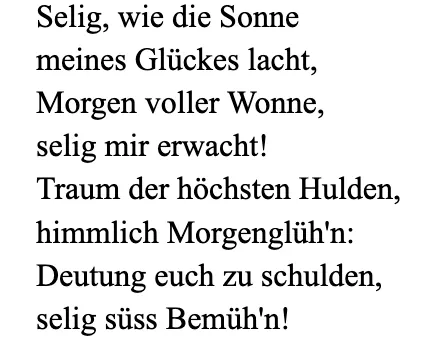
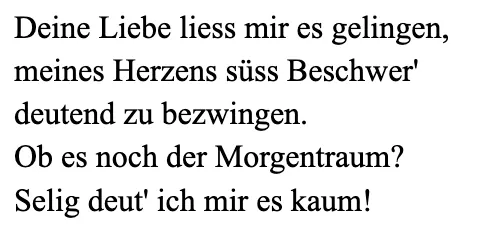
Dressed and ready to proceed to the festival at the river, all has been put in order: Walther, de facto at least, has become a Mastersinger this morning, and all that remains is a wonderful pass of events, half by chance and half by Sachs’s machinations, by which he will be allowed to enter the contest and sing the song he has just composed: Enough to say that in the final version he improvises a stanza that unites Eva in Paradise with Eva the Muse of Parnassus – Wagner’s own vision of Cosima. But before they adjourn to the meadow, Sachs “baptizes” the new song to save it against the hazard of the coming competition; and the whole gathering sings a most beautiful ensemble piece, all the characters proclaiming their joy at the magical outome-to-come, beginning with Eva, then Walther, and then Sachs (please note the way they glide chromatically from key to key!):
Selig wie die Sonne (4 min: text below)
Wagner’s plot owes its ultimacy to the Lutheran background, but he has to make something else of it. Please note that Hans is Johann, and Johann – or John – is the Baptist whose birthday is June 25 –St John’s Day – the day opposite the birthday of Jesus. Without the depth of these Christian allusions the story would lack the ultimacy it enjoys, though the liturgy and the gospel is mangled in the process: As John was the great “precursor” of Jesus, according to the hymn at the beginning of the opera, whose sandals he hardly deserved to buckle, the shoemaker Sachs is the announcer of Walther, and it is his song, not him, that he baptizes. Then Walther “is” Jesus, or the song is, or something… For Wagner, in any case, it is the musical genius Hans the Baptist that is the hero. Wagner’s music is infamously chromatic, gliding easily from key to key in ways that release and stimulate a great emotional response: but, if you will, he is also a chromatic thinker!
*
It would devolve upon The Church to complain about this “chromatic” sort of theology, perhaps indeed upon my Roman Catholic “author” in Vienna who has been trying for years, and has partly succeeded, at turning me against Wagner. Or perhaps the complaint should issue from such a place as the Nonnbern Abbey in Salzburg, where young Maria is a postulant, near the Schloss Leopoldkron, where Captain vonTrapp lives as a widower with seven children whose latest governess has failed to govern them. Maria’s lively enthusiasm for the hills, because music sounds there, though somehow innocent of any pagan strain, continually distracts her from her duties at the abbey. The wise Abbess releases her to a stint of living in the world, and in particular to serve as the Captain’s next governess. What Maria finds to be missing is – yes – music: ever since he lost his wife the Captain has forbidden any music in the household. But Maria didn’t get the message and went and taught the children the Edelweiss anthem; they perform it for him, he cannot resist joining in, and the children flock into his embrace for the first time anybody can remember.
Wagner appropriated to his own worship of musical creativity the revolutionary truth of the Savior’s advent, at the expense of transmogrifying it; but Rodgers and Hammerstein draw off the authentic truth of the holy spirit, love in action, which now melts the father vonTrapp’s desperate reliance on formality, into a life of hope and smiles. Songs sound throughout piece, in the manner of an American Musical, by which Maria teaches the children to sing through their troubles with the motherly lessons they have been missing, from fear over the storm, to adolescent love, the joyful play of the puppets, and the great dance through all of Salzburg honoring nothing more and nothing less than Do Re Mi, the notes of every song that will ever be sung if one is happy enough, and lucky enough, to sing. Only after establishing the ethical dimension of motherhood, does she suddenly fall in love with Georg, while dancing the Landler of course, and with humble chastity she runs back to the Abbey. Whereas Walther just happens into Nuremberg and happens to fall in love, as comedy in general requires, the meeting of Maria and the Captain is a providential event: the Abbess sends her back, and the two of them agree that “somewhere in their youth or childhood, they must have done something right.” The sacrament of their wedding suddenly ensues on a grand scale.
Wagner’s Meistersinger closes with Sachs delivering one final lesson to Walther and the gathered populace of Nuremberg, at the end of the festival: Above all else we must revere the traditions of the Meistersinger’s Art, to preserve the culture and recognition of what it means to be German. It’s heard as an adumbration of Nazi nationalism, especially by those who have slept through the previous five hours of this longest opera in the standard repertoire… Only that could allow the ominous overtones of this somber moment to detract from the great, rounded, and bursting triumph of the piece. It is a sentiment commonly that leaks into current productions, including that production I saw in Bayreuth.
No less does this dark Nazi memory still loom over Old Europe today, troubling the German election with the significant advent of Alice Weidel whom many easily call a Nazi, and so also her supporters. This same darkness invades our story of the vonTrapp family in Salzburg, there in another part of Europe, which ends with their dramatic escape from the Nazis for refusing the Anschluss, fleeing into the those same Alps, where music sounds and music heals.
*
What then of River City, Iowa, on the other side of the world from Old Europe, in the young United States, a country but a couple hundred years old, with a written constitution based on modern ideas, never invaded, hugely prosperous, rich in natural resources, able still to believe and insist with indignation that church and state be separate – unburdened by the past and free to move into the future. Above all, so far at least, we have no inherently insoluble religious wars, our immigration consists largely of Christians who can easily integrate – and we saved Europe from Hitler. Our cultural memory has only the flaw of racist slavery, and we have come out of that far less racist than other nations. But still – and this is the ray of hope for the world – we are just as vulnerable as the Catholic Austrians and the Protestant Germans to the Sound of Music!
One of our most infamous weaknesses is the unsophisticated complacency of our basket of deplorables living in fly-over country, like the Iowa folks who can “stand bumpin’ noses for a week-and-a-half and never see eye to eye.” Such a benighted place is vulnerable also to “an out of town Jasper in a pinch-backed suit” warning the parents their children are idling away their time at the new pool hall, reading the latest issue of Captain Willy’s Whiz Bang, and “rebuckling their knickerbockers below the knee.” They need to get a boys’ band going to keep them out of trouble, which “starts with T and rhymes with P and stands for Pool.” With his “song and dance” Harold Hill stirs the populace to a frenzy, puffing up the vanity of each person he meets, how beautiful their step, their embouchure the likes of the great Gilmore, flattering the matrons into thinking they have a classic sensibility, hearing in the murmurs of tone-deaf children the echoes of John Handy, reconciling between four lifetime enemies by turning them into a barbershop quartet, and maybe even seducing the frozen-over ice-cap of the one true-blue intellectual in the town, Marian the Librarian.
But as to the denouement, it consists in a great reversal: the people do buy into his spiel that the boys will be able to play their music through the Think Method once the instruments and uniforms do arrive, for which the parents have already paid him in cash. His plan was to skip town with the proceeds but he falls in love with Marian, who had merely been his prey, and cannot leave; and she falls in love with him, seeing the hope he brings with his music and his dance, and how it has taken the city in an upward whirl, and seeing also the proud futility of her own protective prudery – the female counterpart, by the way, to vonTrapp’s military way – and so for the first time in their lives he won’t do the wrong thing and she will.
He’s arrested as a fraud, the uniforms arrive, the parents have dragged him into the gym to lead the band, and what happens? This is America – do I need to tell you? She forces the baton into his hand, He sets the beat: “Think, boys, think!” One of them squeezes a toot out of his trumpet and his dad leaps up and calls out “That’s my Billy!” – One after another of the parents pop up, the dream becomes truer and true–r, and then something actually inexplicable occurs. There were no miracles but only providence in the Catholic story, and wonderful human creativity in the Lutheran story, but here, absent trace of reference to Protestants, Catholics, or Jews, a miracle occurs: The paltry uniforms suddenly pop into high bright red with white trim and gold buttons, the band emerges from the gym ten times its size and parades through the square lined with cheering persons: nobody in River City is surprised, nor even are we. It’s just that our dreams came true, as though the thing we knew in their hearts just had to happen, did happen.
Of our three pieces of music and stories there is in this last one not even an allusion to Christianity, and yet of all three this is the only one with a “real miracle” – a resurrection of hope typical of America’s self-interpretation, pregnant with a spontaneous faith that seems to rely upon no rubric here and there, with hardly a trace of liturgy or worship in our sunny cultural memory. The Music Man could never be a European work!
*
When I was a Wagnerian I had the same problem I now have with Trump, approving the works despite the foibles of the man; but when I finally stopped listening to most of Wagner it was because of his ideas, not his personal behavior. I look forward to similar a release from Trump, the man, assuming I still can and still must think.
Thank you for your attention and for our Chit Chat Club!
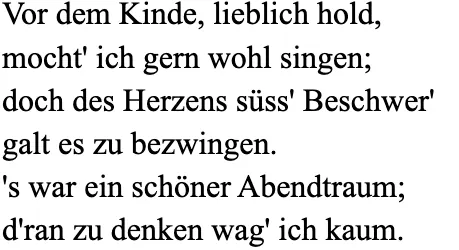
WIE DUFTET DOCH DER FLIEDER
So mild, so strong and full
is the scent of the elder tree!
It relaxes my limbs gently,
wants me to say something.
What is the good of anything I can say to you?
I’m but a poor, simple man.
If work is not to my taste,
you might, friend, rather release me;
I would do better to stretch leather
and give up all poetry.
He tries again to get down
the work, with much noise.
He leaves off, leans back once more
and reflects
And yet it just won’t go.
I feel it, and cannot understand it;
I cannot hold on to it,
nor yet forget it;
and if I grasp it wholly, I cannot measure it!
But then, how should I grasp
what seemed to me immeasurable?
No rule seemed to fit it,
and yet there was no fault in it.
It sounded so old, and yet was so new,
like birdsong who heard a bird singing
and, carried away by madness,
imitated its song,
would earn derision and disgrace!
Spring’s command,
sweet necessity
placed it in his breast:
then he sang as he had to;
and as he had to, so he could:
I noticed that particularly.
The bird that sang today
had a finely-formed break;
if he made the Masters uneasy,
he certainly pleased Hans Sachs well!
SELIG WIE DIE SONNE
EVA:
As blissfully as the sun
of my happiness laughs,
a morning full of joy
blessedly awakens for me;
dream of highest favours,
heavenly morning glow:
interpretation to owe you,
blessedly sweet task!
WALTHER
Your love made me succeed
in interpreting and subduing
my heart’s sweet burden.
Is it still the morning-dream?
In my bliss, I can scarcely interpret it myself.
SACHS
To the child, so charming and fair,
I would fain sing out:
but the heart’s sweet burden
had to be subdued.
It was a beautiful morning-dream;
I scarcely dare think of it.
© 2025 Kenneth Quandt, Ph.D. All rights reserved.