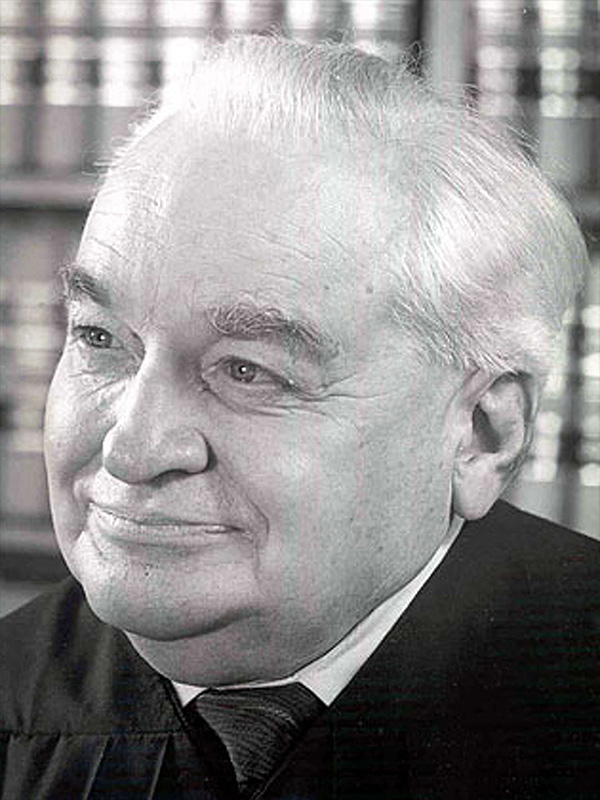

Tonight I want to tell a story which for the most part is true and which, in its basic features, is as old as the Iliad and as new as the TV soap “Dallas.” True stories have no beginnings or endings. A possible beginning could be the year 1889 during which the Hardemans, a family from the Trinity River bottom in east-central Texas moved about one hundred fifty miles west to Williamstown, Texas, a small community in which was located the tiny but well-regarded Methodist affiliated University of the Southwest. A possible ending could be the year 1962 in which an old woman, with auburn-dyed hair and both hands knarled with arthritis, from each of which gleamed a diamond and protruded a lighted cigarette, frequently regaled her grand-nephew with witty, sometimes raucous, comments about everything from her father’s cattle drives to Vicksburg during the Civil War to the latest rumors about John Kennedy’s sex life. The grand-nephew was entranced and often sought the company of this lady who in 1889 was Sabrina Stacy, a vivacious child in the town into which the Hardemans had just moved.
ORIGINS
My story actually commences before 1889 but does end shortly after 1962. The Stacys, even in 1889, were long-time residents of Williamstown. They were three brothers who had come from Missouri in the early 1850’s. They settled a few miles from Williamstown in the midst of beautiful rolling plains marked by spring-fed streams. Even then the Stacys were better off than most of the residents in that area. They attached themselves to a fairly successful relative who had preceded them. Most of the area’s residents lived on game, including buffalo, and cornbread, and used tents or crude one room cabins for shelter. Indians posed a minor problem of steadily diminishing proportions.
The brothers, functioning like the preindustrial revolution long distance traders in Europe, engaged in haulage and trail driving between widely separated markets, including during the Civil War drives from Texas to Confederate armies east of the Mississippi. Their cowboys were governed by three rules rooted in their stern version of Methodism. These were:
First: You can’t drink whiskey and work for us.
Second: You can’t play cards and gamble and work for us.
Third: You can’t curse and swear in our camps and work for us.
Sabrina, the daughter of Tom Stacy, the middle Stacy brother, was born in 1881 in Williamstown. The Hardemans, with whom she was to be united for all but nineteen years of her life, first appeared in Texas as early as 1838 in the person of a thirty-four year old Methodist circuit rider from the Mississippi Conference named Josiah Hardeman. Converted in 1824 during a camp meeting near his father’s home a few miles from Nashville, Tennessee, Hardeman had progressed from exhorter to itinerant while bringing the gospel to settlers scattered in the back woods of Mississippi and Texas. Handicapped by almost no education his progress in the church was slow.
Josiah went back to Tennessee in the early 1840’s and returned shortly thereafter with a wife whose station in life was somewhat above his own. They took up land near the Trinity River and from their union three children were born. The second, named Henry, was the Hardeman who moved to Williamstown in 1889, the year Sabrina reached her eighth birthday.
Following the Civil War, Henry had commenced farming and small sale ranching. He did well. By clearing and draining the rich swampy land on the banks of the Triniy he was able to produce bountiful crops of cotton. He married a neighboring rancher’s daughter who died in 1883 at the age of 30 after bearing four children. The second was a boy named Thomas Bell — Bell being his mother’s maiden name — with whom Sabrina was to spend a long and sometimes turbulent life.
Henry’s holdings began to grow. More and more his eyes turned westward. The Indians were being pushed beyond the Texas borders and the buffalo on which they depended were substantially exterminated. Barbed wire and the windmill made closing the open range practical. Henry began to acquire land in west Texas.
Approaching his fortieth year with his farming and newly commenced western ranching activities widely dispersed and his children cared for by a middle-aged aunt, Henry needed two things — a new wife and a new home more centrally located with respect to his expanding business interests. All his Tennessee cousins, as well as his in-laws, had the answer to the first problem and he thought he knew what to do about the second. The joint solution was to marry his deceased wife’s youngest sister, then in her early twenties, and to move to Williamstown. There the Stacys and their cattlemen neighbors resided and the rail connections, schooling for children, and climate were better than at Josiah’s old place on the Trinity. So he married his sister-in-law, and in 1889, leaving the graves of his mother, father, first wife, and sister behind, he moved to Williamstown where Bell and Sabrina first met.
Another child in Williamstown with whom Sabrina played was young Alfred Brown Gates, Jr., a lad of nine when Bell Hardeman came to town. Al’s father was born in Williamstown in 1842, served honorably in the Confederate Army, and in due course became associated wtih the Stacy brothers, serving primarily as a trail boss and foreman in which capacities he participated in many of the long drives of Stacy cattle. His family resided in Williamstown. By 1889, however, he had undertaken to be the manager of a three million acre ranch owned by a London based group called the Capital Syndicate and located in the western portion of the Texas Panhandle. Strongly recommended by the Stacys, who sold numerous herds of cattle to the Syndicate, A. B. Gates assumed his new responsibilities in 1887, although his family remained in Williamstown for some years thereafter.
Captain Gates, all Confederate veterans by the 1880’s being entitled to this rank, unless they had a higher commission while serving or “earned” it later by success in business, was a Methodist also. The three Stacy rules mentioned earlier did not trouble him; indeed these rules were expanded by him into several pages of regulations during his work for the Syndicate. He was strong, forceful, opinionated, with an unfortunate tendency to interfere in the affairs of others. No doubt that habit contributed to the tragedy that engulfed these three families twenty-three years after they first lived as neighbors and friends in Williamstown.
EARLY YEARS
An outline of the future character of each of the children, Sabrina, Bell and Al, had emerged by the time they reached their teens in the mid-1890’s. Al, the oldest by a year or two, standing a bit over six feet, was a tall, narrow-waisted, reasonably handsome young man already mastering the skills of riding, roping, driving, and shooting that a good cowman had to possess. Unfortunately, he also exhibited, although to a lesser degree, the same dogmatic manner that caused Captain Gates so much difficulty throughout his life. His mother was a quiet and cool-headed woman, who exercised a strong, but by no means dominating, influence over Al. It is not surprising that the girls found Al attractive.
Certainly Sabrina did. Although by no means beautiful, she gave promise as she approached her fifteenth birthday of becoming a handsome, quick-witted woman blessed with beautiful auburn hair and a passable figure. Already her ability to charm the young and the old, women as well as men, was strongly evident. She had an instinct for the ridiculous which inspired her humor–usually good natured with a bite–but at times crossing the line into cruel sarcasm.. Like many others Al found Sabrina worth seeing. Later on it was said they then became sweethearts. Perhaps so. What passed between them, however, no one knows.
At this time, Bell didn’t figure prominently in the lives of Sabrina and Al. He was a new boy in town whose family had no part in the already developing legends concerning the years of the open range cattle business. Although Captain Gates had been, in a sense, a Stacy “hired hand” he was, like Sabrina’s father, a part of that tradition while Bell’s family sprang from the pulpit and the soil. Bell was, however, intelligent. Unlike Al whose reading and writing were, to say the least, not facile, Bell had no difficulty in school. By the time he was fourteen his emerging skills in rhetoric were recognized. Henry was very proud of him. Having struggled for years to shake poverty and, as he sometimes put it, “to get my hands out of the dirt,” he saw in Bell the possible achievement of his most extravagant dreams. “This boy,” some said, “would someday be governor.”
Bell’s adolescence was not entirely happy, however. Although, like all Henry’s children, his features were clean and straight, he was quite short and a bit on the pudgy side. His five feet seven inches height disadvantaged him severely in dealing with his older brother, James, whose features were even better than Bell’s and who measured over six feet. The two brothers were very close, however. James, the unquestioned leader, was unusually handsome. He expected admiration, particularly from girls, and generally got it. It was not so easy for Bell. People always find good looks when combined with amiability, less threatening than high intelligence. Put simply, it was easier to love James than Bell.
In 1895 Al left Williamstown to join his father in the management of the Capital Syndicate ranch. Whether Sabrina and he corresponded is not known; however, it is doubtful that many letters passed between them. Not long after Al’s departure the entire Gates family moved to the ranch headquarters located in the newly established town of Bledsoe, named after an organizer of the Syndicate.
I know little of Sabrina’s life immediately after Al went west. No doubt she blossomed and had many “beauxs,” as boyfriends were called in those parts as late as the 1930’s. Perhaps Al returned to Williamstown occasionally and saw Sabrina, but of this nothing is known. What is reasonably clear is that, although Al had a special place in her affections, he was not “the one and only.”
Some proof of this lies in the fact that in 1898 she commenced seeing Bell, then a student at the University of Texas Law School. Henry had seen to it that Bell was educated. He remembered grimly some of the humiliation suffered by his father, Josiah, at the hands of the Methodist clergy who not only used his near illiteracy to bar his advancement but also, at the close of his days, refused to recognize his service by the award of a token pension. His son, Bell, would show the world. To this end Bell had enrolled for a year at the University of the Southwest in Williamstown and then at Princeton where he attended the lectures of, and came to know, a rising professor of jurisprudence and political economy, Woodrow Wilson. Fifteen years later this professor, then in the early stages of his presidential campaign, was to serve as one of Bell’s desperately needed character references. It is doubtful, however, that Bell graduated from Princeton. More likely Bell persuaded Henry to permit him to return to Texas to attend law school prior to graduation. James was already in the banking business under the wing of the now Colonel Gates in Bledsoe and Bell, as always, felt the urge “to keep up” with his handsome brother. Henry probably did not find it difficult to let Bell have his way inasmuch aa being an attorney had been his impossible youthful dream.
MARRIAGE
Bell’s legal education and his courtship of Sabrina proceeded along parallel tracks and culminated in the receipt of his law degree in June, 1900 and their marriage on October 17, 1900. In this manner the two families, the Stacys and the Hardemans, were united. There was symbolism in the union: the line in Texas between farmers and cattlemen was becoming less distinct; so now also was the line betwen the Stacys and the Hardemans. Nonetheless, all Williamstown knew that it was the Stacys who had admitted the Hardemans, not the other way around. No record of which I am aware suggests that Al attended the wedding or that he even communicated with Sabrina.
But was the wedding more than a symbol of economic change and the Hardeman’s arrival? Did Sabrina love Bell? Did he love her? He said he did and during the later troubles said so under oath. But what of Sabrina? The remainder of my story perhaps supplies the answer.
I know little of the early years of Sabrina and Bell’s marriage. Two children, a girl and a boy, were born in 1902 and 1906, respectively. The son died in 1918, a victim of the great flu epidemic, while the daughter survived her partents by many years. It is clear, however, that pursuit of the law with its then long apprenticeship, during which the tyro defended those accused of minor crimes, drafted simple contracts, leases, conveyances and wills, and ingratiated himself into the community by engaging in church work and politics, did not appeal to Bell. James was now into the cattle business with his father where the game was faster and the stakes larger. Bell would not be left behind. Nor was Sabrina of a different mind. She was a Stacy.
By 1904 Bell and Sabrina had moved to Amarillo where Bell gave up the practice of law entirely and devoted himself to a partnership with James. Together they operated a ranch just to the north of the Canadian River located in part on land that Henry had recently acquired following the dissolution of the very large LX ranch. Bell also ran a ranch with a reasonably suitable headquarters house in Cottle County near the small town of Paducah.
Shortly after the move to Amarillo Bell and Sabrina built a nice and comfortable home. Just a few blocks away was the home of Colonel Gates who had abandoned Bledsoe for Amarillo. The Stacys, Gates, and Hardemans were once more neighbors. For a while yet, they were still friends.
THE OTHER MAN
But something began to happen during 1910. Bell always contended that it was in that year that Sabrina commenced to suffer from “bad health.” To Amarillo’s altitude and harsh climate he attributed her illness. Perhaps he was partially right. In 1910 the high plains of Texas were hard on women. But the monotony and boredom of the life of a rancher’s wife whose husband was gone two out of every three weeks were also hard. It is undisputed, however, that in 1910 Al returned to Amarillo from a Syndicate ranch in Wyoming. Still a bachelor, he lived with his father and mother a few blocks away.
It began innocently enough. Sabrina and Mrs. Gates were fairly close, the latter perhaps serving at times as a proxy for Sabrina’s mother with whom the young woman had never felt entirely comfortable. Mrs. Stacy was a pioneer woman whose personality had been pounded out on the anvil of work, lonliness, danger, and evangelical Methodism. Mrs. Gates had shared the same experience but she emerged a bit more warm and tolerant. Upon Al’s return, Mrs. Gates asked Sabrina to suggest some books for him. She did; discussion of the books by Al and her followed; and within a short time the impromptu library exchange was in full swing.
During the summer of 1911 Mrs. Gates became disturbed by what she sensed. It is very likely that, after being unsuccessful in her efforts to halt what she knew might lead to at best painful and at worst tragic consequences, she informed the Colonel who in due course visited with Henry and Sabrina’s father, Tom, about the situation. No one regarded it as a matter involving only the three people most directly concerned. No such attitude could have existed then within families of their standing. Strength, pride, honor, and independence were their hallmarks.
Without consulting Al or Sabrina, and without infoming Bell, the council decided that the budding affair should be nipped. Mrs. Gates approached Al while Tom and Mrs. Stacy talked with Sabrina. The results were predictable. Both denied that there was anything between them and asserted that the concern of their parents was unjustified. Henry told Bell nothing. Instead he brooded about what could be done to safeguard his son and his grandchildren while the Colonel muttered harsh words about Sabrina in his conversations with his wife. Tom neither then nor later had any doubt about where Sabrina’s duty lay. It was to be a good wife to Bell. Viewed from the manners and morals of today it appears that too much of the burden of maintaining fidelity was being placed on Sabrina, but in their mind Sabrina, the woman, bore the temptress Eve’s curse of guile and required strong protection and control. Al, on the other hand, was a man, more particularly a man of the range, accustomed to taking what was there to be had.
It is not difficult to imagine Sabrina’s feelings. She was exhilerated just as is a mountain climber during a dangerous passage. Gone were the monotony and lonliness, and in their place was a sense of being wonderfully alive. Perhaps she did love Al, but perhaps — well, she was content to let the future supply the answer.
THE CONFRONTATION
Several months passed and then it happened. As Bell later told it, he returned home at noon one day around October 1, 1911 and observed Al in Sabrina’s bedroom holding her hand while she lay abed recovering from a minor operation. When asked about it after Al’s polite departure Sabrina explained that she was only showing him the purple color of her fingernails — supposedly caused by the operation. Bell was not immediately reassured, words passed, then tears flowed from Sabrina’s eyes, and a reconciliation of sorts ensued. Bell left home on business shortly thereafter, and returned on October 13, four days before the eleventh anniversary of his marriage to Sabrina.
It was then that Sabrina told him. According to Bell’s story again, which is all we have since Sabrina never told hers, she took him out on a side porch of their home and informed him that she wanted a divorce so that she and Al could marry and go to South America to live. She said she wanted both children, but that she would agree to take only one. She also said that Al had wanted them to go away without telling Bell but that she would not agree to that.
There followed hours of argument during which Bell, in a thousand ways, asked “Why” and she, in response, repeatedly said, “Because I love him and not you — never have and never will.” The day turned into evening and then into the next day’s early morning at which point Bell, with pistol in hand, threatened Sabrina’s life. The oldest child, who had been listening from behind the door, came screaming into the room and that moment of dangerous anger passed.
BELL’S RESPONSE
Unquestionably the rational part of Bell’s mind was functioning to some degree even during this emotional confrontation. By telegraph he summoned Sabrina’s father and mother and refused to talk to Henry who, in some unknown manner apparently forewarned of the confrontation, was in Amarillo visiting his daughter only a few blocks away. Bell’s counterattack already had taken shape in his mind. No balanced woman of Sabrina’s position would contemplate the course of action she proposed, therefore she obviously was unbalanced. The duty of a good husband under such circumstances was to place her in a good private sanitarium where she could be treated.
Who can say what less forthright or rational forces shaped this decision? Guarded confinement was clearly necessary to keep Al away. Bell could not be her guard. His business would not permit it; besides it would be dangerous. Under the then prevalent code husbands were supposed to kill paramours. Al, however, was a better gunman than Bell could ever be. The insanity theory had other advantages, it eliminated the necessity of Bell’s confronting his own failures as a loving husband. “Why cannot I be loved as others are?” perhaps he subconsciously cried out. “Big amiable James. Damn him. Why am I not he? This would not have happened to him.”
The next morning Bell and Henry met. Henry’s brooding during the past several months had led him to a startlingly modern conclusion. It was to let Sabrina go. How this sixty-three year old man of the nineteenth century came to that view is not known. Always a man of foresight, especially in business affairs, perhaps he saw the looming shape of tragedy. Perhaps he had come to realize that a husband’s bruised pride heals quickly while there is no cure for the agony that besets partners of an unwanted marriage. In any event, he gave his advice and Bell rejected it immediately, There was no argument. Henry, I am certain, in his heart repeated King David’s lament concerning his son Absolom. To Bell, however, Henry stoically offered his complete support.
At about the same time–at least no more than a few days later–another conference between a father and son took place. Al and the Colonel talked. The Colonel stated that he didn’t trust Sabrina; that she was a bad woman; that Al would be better off if he walked away from her. Al, like Bell in his response to Henry, said he could not do that. He and Sabrina loved each other and they wanted to go away and start a new life together. The Colonel argued his position, but to no avail. Finally, he said:
“Son, can you keep her if you get her?”
“Of course I can. She has led a miserable life with Bell. He’s not the kind of man she wants and needs. He’s gone for weeks at a time and neglects her when he is home. He’s nothing but a shyster lawyer trying to be a cow man.”
“Maybe,” said the Colonel, “but when you get her she brings trouble. You will have to deal with Bell and you will need a great deal of money to support her and start over at the same time.”
Al could not deny that this was true. Finally, he said,
“Papa, you are not going to let Bell Hardeman back us down, are you?”
The Colonel, who never had any intention of letting the Hardemans make a fool of his family, answered:
“No, by God! If you don’t want her, they deserve her. If you want her and think you can keep her hitched, take her. She’s a slut if she stays with Bell; but she’s a Gates if she goes with us. As for the money, we can raise it.”
Thus passed an opportunity to avert the onrushing tragedy. Events thereafter moved quickly. Bell, Sabrina, her sister and brother-in-law took the train to Arlington, Texas where the sanitarium selected by Bell for Sabrina’s “rest and cure” was located. Grave conferences with doctors, resident and non-resident, ensued. Bell explained over and over again that he wanted nothing but the best of care for Sabrina, his beloved wife, that she was “not well,” and that the harsh climate and altitude of Amarillo had been too much for her. Sabrina, I suspect, played the role assigned to her by Bell. She was in contact with Al and between them a plan had been developed. No one knows how this contact was achieved but that it existed is clear. It is hard to believe that the doctors did not realize that they were being made the custodians of an unhappy wife of a deeply troubled marriage. The doctors, nonetheless, told Bell they would do what they could.
Bell’s next task was to take steps to see that his two children were safe and cared for properly. He moved them to his ranch near Paducah and put his sister-in-law in charge. This was a safe place. No one could approach the ranch without there being a high probability of being seen. Bell was aware of the importance of the children in his struggle to keep Sabrina; if Al could get control of them Sabrina was lost. This he could not permit. Throughout the next few weeks Bell interrupted his frantic and wide ranging travels to visit these children, his hostages in an increasingly dark struggle.
SABRINA’S FLIGHT
Bell also visited Sabrina frequently. Her anger, in part feigned, subsided and with each visit she showed increasing affection. Both Bell and the doctors were encouraged. Perhaps it would all work out after all. Then Bell got a telegram from the doctors while he was in Paducah stating that Sabrina had disappeared. He rushed back to Arlington. The story he heard was told by Sabrina’s private nurse. She and Sabrina had been to Fort Worth to see a picture show. As they were waiting for the interurban car to return to the sanitarium Sabrina suddenly took a different car calling to the nurse that she was going to Paducah to see her children. She had not been seen since. It was now November 10, 1911, two days after the escape.
Bell went into action. Police were notified; hotels checked; pawn shopkeepers interrogated; and conductors of cars running by the stop at which Sabrina disappeared, according to the nurse’s story, were questioned. Bell, armed as he had been since Sabrina confessed her love for Al, threatened the nurse but she stuck to her story. However, when later confronted with the information that no conductor passing the spot from which Sabrina supposedly disappeared had seen the two women, and the fact that the two had been seen in a department store buying clothes for which Sabrina paid from a large role of bills, the nurse broke down and told a different story.
She said Sabrina, after swearing her to secrecy, had agreed to buy her an expensive dress if she would take Sabrina to Fort Worth to meet Al. She agreed and they met Al and another man outside the picture show they were to have attended. He gave Sabrina a large roll of bills with which she was to buy several outfits suitable for cold weather together with accessories as well as the dress promised to the nurse. After shopping they met Al and the other man at the train station. The nurse then returned to the sanitarium and told the story that Sabrina had paid her to tell. In this way Al and Sabrina had a head start of almost a week.
Armed with Henry’s financial support and the outrage appropriate to a man whose “insane” wife had been abducted by a home breaker, Bell commenced the hunt. The Burns Detective Agency was engaged and the questioning of ticket agents, station personnel, and pullman porters got underway. The nurse swore she did not know where Al and Sabrina were headed. In due course it was established that two one way pullman tickets to St. Louis on the Frisco line had been purchased by a man matching the description of Al’s associate. A third one way pullman ticket to a point well short of St. Louis also had been purchased. This information led to the pullman porter who had served the car on which the three had reservations. He verified that the three had traveled in his car and stated that Sabrina had spent a tearful evening in a lower berth shared with Al.
The hunt moved to St. Louis and, while Burns attempted to pick up the trail there, Bell hurried to New York to enlist the aid of a former Princeton classmate now prominent in New York banking circles. It was possible, Bell thought, that Al and Sabrina had gone to New York to obtain passage to South America. With the banker’s aid, the local police and additional men from Burns checked the train stations, hotels, and steamship lines, but to no avail.
Three weeks had now passed since Sabrina had disappeared. Already Henry and some of Bell’s close friends were advising him to give up the hunt. One of the latter, a business associate of Bell’s, told him that the Colonel was saying to his friends in Amarillo that Sabrina was a whore, that Bell was a fool, and that he doubted that Al would want her after a few months. Bell was outraged because he strongly suspected that the Colonel had supplied the money Sabrina was flashing about in Fort Worth and that he was in contact with Al wherever he was. There was no chance that Bell would abandon the search.
SABRINA’S RECAPTURE
It was now December, 1911. The Burns people combed the country. Al and Sabrina were traced to Omaha, Chicago, and Minneapolis. They were then discovered in Winnepeg, Canada, and arrested by Canadian authorities on December 26, 1911.
In the meantime Bell was pressing for indictment of Al by Texas authorities for abduction and by federal authorities for violation of the Mann Act. The U.S. Attorney, later a federal district judge in Texas for many years, was a friend of Bell’s and the state’s attorney was also receptive. This activity brought the Colonel to attention. He undertook to block these moves but his efforts were not productive as long as the whereabouts of the lovers was unknown. Nonetheless, his role subtly changed from that of passive to that of an active participant; from that of a loose-tongued concerned parent to that of a near accomplice.
The news of Al and Sabrina’s whereabouts turned Bell toward Winnepeg, Canada. Accompanied by a Burns agent and heavily armed, Bell reached Winnepeg on New Years Eve, 1911. Immediately he visited the American consul who informed him that the fugitive pair were being temporarily held by the Canadian authorities. Through the friendly U.S. Attorney back in Texas the United States requested that they be deported as undesirable aliens. At this point Bell took two prudent steps. The first was that he consulted a Canadian lawyer who told him that he would be hung if he should kill Al in Canada–a thing Bell had been threatening to do for some time. Perhaps the threats were empty but, in any event, neither Bell nor Al shot at one another in Canada. The second wise step was to file a complaint with Canadian authorities charging Al with the theft of Sabrina’s diamond rings which had been in Al’s pocket when he was picked up by Canadian authorities. This served to hold him in Canada for at least a brief period while Bell took Sabrina back to Texas. This occurred on January 4, 1912, a year still etched in the collective memories of the three families of Williamstown whose story I am telling.
I can only imagine Sabrina’s feelings during November and December of 1911. That she loved Al there seems little doubt. That she was willing to forsake her children and her family for him is far less certain. Clearly she wavered toward abandoning all and, had Bell not pursued so effectively, might well have done so. Above all, however, she revelled in the attention she was receiving. A proud and handsome woman pursued by two ardent lovers, aided by small private armies, was a role that she, like her sisters in history, literature, and song, found exhilerating. However, I like to think, although I know not, that during those days and nights while she enjoyed Al’s embraces there emerged the first inkling that she had become a part of forces too primitive to permit responsible control by anyone.
Whatever her feelings were she did not eagerly greet Bell when they met in Winnepeg. In fact, she was angry at being brought back to the United States a virtual prisoner. Bell’s plans for Sabrina remained as they were in October. As quickly as it could be arranged Sabrina was to be returned to the sanitarium until she recovered her “sanity.” Prior to this she would remain in care of her father in his home, then located in Clayton, New Mexico.
So Sabrina found herself under her parent’s roof once more. Immediately she began an effort to turn her entire family against Bell. She bitterly complained of the living conditions in the sanitarium and convincingly demonstrated by word and deed that she was not insane in any ordinary sense. Indeed, her brother-in-law in a conversation with Bell said that her “insanity” was only “moral insanity” at worst. Sabrina also revealed a card in this tense game that caught Bell completely by surprise. While with Al, at the insistence of the Colonel and his attorney son, Sabrina had executed a general power of attorney giving to a partner of a Fort Worth law firm full authority to manage her affairs including the seeking of a writ of habeas corpus should she be incarcerated anew in a mental sanitarium. Messages between Sabrina and Al also passed, with the knowledge of her family, while she remained in New Mexico.
DEATH OF THE COLONEL
She also received a message from the Colonel. Its essence was contained in a line that journalists in a few short weeks would find irresistible. “If you will stand hitched, the Gates will stand hitched.” The letter was shown to Bell by a member of Sabrina’s family. The Colonel was now engaged in the battle as far as Bell was concerned.
One must wonder about the state of Bell’s mind at this juncture. True, he had Sabrina back and continued to enjoy the open support of the Stacys. Henry, despite his deepening belief that Bell’s cause was ill advised, if not hopeless, continued to be willing to finance Bell’s efforts to preserve his home. And, of course, Bell’s brothers and sisters stood behind him solidly.
However, with the benefit of hindsight, it is fairly obvious that Bell’s cause was at a low point. It is difficult to believe that Bell did not experience at the end of long days during which he jumped from one crisis point to another–from business, to legal efforts to ensnare Al, to plans to “hospitalize” Sabrina, and to measures to preserve his custody of the children–a sense of deepening despair. He had lost Sabrina’s love and, perhaps, even her respect. His efforts to ensnare Al with criminal charges no doubt would come to nothing now that Sabrina was back. His business was being neglected. “Hospitalization” of Sabrina would be difficult in view of the Gates’ possession of her power of attorney. A long expensive court battle would be required to defend against a petition for habeas corpus. The defense, moreover, very likely would be unsuccessful.
The key to any hope of ultimate success by Bell continued to lie with the two children. He must not lose them. I imagine he knew in his heart that Sabrina would not initiate divorce proceedings as long as her chances of obtaining custody of the children were as poor as they presently were. On the other hand, “capture” of the children by the Gates would change everything. The custody of Sabrina by “hospitalization” then would surely fail. Who long could hold a mother from her children now in the hands of her lover to whom she wished to fly? Divorce with custody of the children would follow quickly in some jurisdiction other than Texas. Bell was gravely wounded and loss of his children would be a mortal blow. So his dark thoughts must have run.
The dread that I think gripped Bell’s heart was not shared by Al and the Colonel I suspect. They were winning. Al was in love. He wanted Sabrina to be his wife and he knew she wanted him. Bell was a nuisance and possibly dagerous, but he was no match for Al who knew that he was bigger, stronger, better looking, a better shot, and, most important, better financed. The Colonel could outspend Henry if it came to that. And the Colonel agreed. He had brought herds of longhorns from the thickets of East Texas to markets thousands of miles away, he had managed the Capital Syndicate Ranch that stretched over several Texas counties, and now he was president of the leading Amarillo bank. He was accustomed to winning and he didn’t intend to lose this intriguing domestic war. True, Sabrina was of a generation he did not understand. No woman of his time would have attempted what she was trying, and if one had, no doubt her husband would have “spanked” her into submission. Bell should have done that. But he hadn’t, and there was no help for that.
That the Gates discussed Sabrina’s children is also very probable. She kept them before Al in her clandestine messages, the import of which was plain. Get the children by one means or another and I am yours. On that condition she indicated, to use the Colonel’s phrasing, “I will stand hitched.” So with increasing intensity all sides focused on the children. Plans by the Gates to “capture” the children were made and discarded. Plans by Bell to move them to more safe quarters, such as Henry’s home in Williamstown, were considered and discarded.
On January 12, 1912, Sabrina, Bell, her mother, and brother-in-law boarded the train in Clayton, New Mexico and headed for the sanitarium in Fort Worth which was prepared to receive its now somewhat notorious former patient. I say “notorious” because many of the events of which I speak had been headline material. Few literate people in Texas did not know something about the affair. Bell was apprehensive about the possibility of being met by state officials acting pursuant to a state writ of habeas corpus; he countered by wiring his friend the U.S. Attorney to meet him at the station in Fort Worth. The federal charges against Al were still pending, although the abduction charges under state law had been dismissed following intervention by the Colonel.
The arrival in the afternoon of January 13, 1912 went smoothly, however. No writ servers appeared and Sabrina was returned to the sanitarium where twenty four hour “nurse” service was put in place. Bell and Sabrina’s brother-in-law, after being met by the U.S. Attorney, agreed that the three of them would meet at the Metropolitan Hotel in downtown Fort Worth to discuss what next should be done. Al was still entangled with Canadian authorities, although their hold was slakening, and federal prosecution remained a possibility.
I do not know everything that happened after the three met in the Metropolitan Hotel. It is certain that the three met, decided to go across the street to eat supper, and that as they turned to leave the lobby of the Metropolitan Hotel the Colonel called out to the U.S. Attorney from a chair in which he was sitting. Apparently none of the three had known the Colonel was in Forth Worth. Bell and his brother-in-law left the Hotel immediately and walked across the street to await the U.S. Attorney who remained behind to speak to the Colonel. In a few minutes he rejoined the others and supper was commenced in a nearby restaurant.
The U.S. Attorney told Bell that the Colonel had urged the dropping of federal charges and that if they were pressed he would see that Sabrina’s reputation was destroyed even if he had to put Henry on the stand in doing so. The Colonel knew his man; Henry would not lie under oath for anyone. No doubt the Colonel in his blustery way said other things that were reported by the U.S. Attorney. Hardeman tradition holds that the Colonel treatened to have Bell’s children taken from him as soon as Sabrina was freed from the sanitarium by one means or another.
By the end of the meal, during which Bell received some advice from the U.S. Attorney about how to prepare for the habeas corpus proceedings, Bell was angry and distraught. The group broke up and without warning to the other two, Bell returned to the Metropolitan Hotel. What was going through his mind no one ever knew for certain. As he told it, the return was a spur of the moment thing. However that may be, what happened next startled the entire State of Texas. Bell walked into the Metropolitan Hotel lobby and over to the chair in which the Colonel was still sitting and without warning shot him three times. The Colonel was killed instantly. Bell, thirty-five years younger than his victim, left the lobby immediately and turned himself over to the authorities at the nearest police station. As a wire to Al in Canada put it: “This means a feud is on.”
BELL’S FIRST TRIAL
And so it was. The killing of the Colonel framed the issues which now were both public and private. Would Bell hang for killing the Colonel was the public issue. Issues even more titillating to the people were which of the lovers would kill the other, and would the survivor get the girl. Newspapers ferreted out as much information as they could and public opinion began to form.
Initially the public was outraged. How could a young man justify the killing of a true patriarch of Texas? However, it is in the nature of journalism to examine closely the claims of underdogs. Stimulated in part by the skill of two bright attorneys now representing Bell, a William McLeisch and John O’Leary, the “trial” of the deceased and his son, the surviving paramour, commenced in the newspapers. As we know, the Colonel had not been a lovable man. His intermeddling tendencies, well known to many, were exploited as were his part in the affair. The threat to kidnap Bell’s children was played up as well as the Colonel’s “stay hitched” letter to Sabrina. Rather swiftly sympathy for Bell developed which, while not condoning his killing of the Colonel, acknowledged that provocation existed. McLeisch and O’Leary dispatched dozens of agents who, by employing one ruse or another, interviewed a sample of prospective jurymen to ascertain their attitude toward Bell. They found that feelings were intense but that there was a basis upon which they could work during the forthcoming trial providing they chose the jury properly.
The theory of their defense was obvious to everyone. Law students and law office apprentices in Texas for many years had been taught that there was an “unwritten law” in Texas that made killing in defense of the home justifiable homicide. It was, I suppose, more a part of the social code than of the state’s jurisprudence. Nonetheless, as an idea it existed and it was Bell’s only hope if he was to escape a hangman’s noose.
Its use, however, presented to McLeisch and O’Leary at least two unique problems. The first was whether it could be extended to the paramour’s father. Probably the judge would not exclude the evidence necessary to invoking the “unwritten law” but it was likely that he would instruct the jury to ignore it. Bell’s real hope, however, lay with the jury. He had to convince at least one of the twelve that the “law” justified his act. This was the not small task of McLeisch and O’Leary.
The second problem was perhaps even more intractable. It was whether Bell, at the time of the killing, had a “home” to defend. A frustrated husband whose wife has abandoned him for another should find it difficult to invoke the “unwritten law.” Its purpose was to protect good women, who preferred their homes and husbands to the blandishments of paramours, but who were momentarily swept from their feet by the sweet nothings whispered by home breakers. The trouble was Sabrina did not fit the part. It was known by all who read the newspapers that she loved Al and that she would like to marry him provided she could get her children.. Her petition for habeas corpus in the state court had been filed and was set for hearing within days. In no way could it be said that she sought the comfort of her husband’s affection and love.
No one knows how Bell and his attorneys dealt with this problem. Perhaps Bell gave her money or property. All that is known is that Bell gave up his resistance to the habeas proceedings, that she left the sanitarium, and that she testified in the trial that although she loved Al she had given him up and would be a good wife hereafter. Henry was disgusted and let Bell know that should he be acquitted he should turn his back on Sabrina forever. He backed up his advice with threats to disinherit Bell should his advice be rejected. Bell, however, had no intention of leaving Sabrina; he was still playing to win.
Unlike present day justice, the judicial process in Texas at that time moved swiftly. Bell’s trial commenced on January 29, 1912, only sixteen days after the Colonel was slain. The Hardemans, led by Henry and including in-laws, assembled in Forth Worth, resided at the same hotel, and occupied one portion of the courtroom space allotted to spectators. The Gates, in a similar fashion, also assembled but without Al who appears prudently to have remained out of the state. It was to no one’s advantage to have a shoot out in the courtroom. Bell, although in custody, nonetheless took the precaution of having two private bodyguards accompany him whenever he appeared in the courtroom. This was not a needless precaution. Public feeling, although swinging to some extent toward Bell, was very high. In one dispute that sprang up in a crowd of would-be spectators outside the courthouse gun play erupted which left four men dead.
The trial was long. All that I have related and considerably more was spread before the jury. Henry testified on behalf of Bell stating that he had agreed to stand behind his son even though he thought Bell’s love was misplaced. His obvious rectitude was impressive. A man with a father like that cannot be all bad was an impression that Henry, under the guidance of McLeisch and O’Leary, conveyed to the jury. The Colonel’s “stay hitched” letter and some of Al’s love letters were admitted into evidence. Woodrow Wilson made available a telegraphic character reference for Bell.
However, it was upon Bell that the defense ultimately rested. What kind of man was he? This was the question the jury ultimately had to answer. Was he a vengeful little man willing to kill a relatively helpless elderly prominent citizen as retribution for the injury to his pride caused by the loss of his wife’s love? Or was he a young man struggling against the lust of a paramour, backed by the wealth and influence of his father, to protect his children and their home from destruction? There were ample facts to support either viewpoint. Bell made an excellent witness. His testimony was factually accurate, replete with details, and presented with an openness and sincerity that was almost bewitching. This served to exploit an advantage that circumstances and the intrinsic character of the trial provided. Bell had the stage to himself. Neither of his antagonists could share it although both, in effect, were on trial also.
The jury received the case in the third week in February. The “unwritten law” was simply ignored in the trial judge’s instructions. The jury did not return quickly. Finally, on the last day of February, 1912, it returned and announced that it was deadlocked at 7 to 5 for acquittal. Bell, McLeisch, and O’Leary had wrought a miracle — a mistrial in the prosecution of a defendant whose prudence, in turning himself in to the authorities a month and a half ago, had avoided the strong possibility of his being lynched.
THE DEATH OF HENRY
Interest in the affair throughout the state increased following the mistrial. Was the matter now Bell against Al — mano a mano? Or were the Gates and the Hardeman’s about to launch a feud in which the men on both sides would participate with additional casualties and prosecutions the inevitable result? Or would Al recognize and abide by Sabrina’s statement under oath that she intended to be a good wife to Bell thus bringing the entire matter to an end? Or would the two lovers elope once more? And, if they did, would they be able to take the children with them? No hunting trip, “forty-two” party, or courthouse lawn conversation possibly could lag so long as these questions were unresolved.
The widow of the Colonel made it clear how she wanted it to end. She wanted no more killing at whatever price. If this required that Al and Sabrina forsake each other that was the way it must be. Henry held a similar view. That is, the killing should stop even if that meant that Bell should give Sabrina a divorce with custody of the children. Perhaps in another age in a different place these two, as the leaders of their respective clans, could have worked out a solution that would have avoided what followed. However, in this case it was not to be.
In any event, Bell did not intend to give up Sabrina or their children. As a tactical matter he needed them to be by his side when he was retried for the murder of the Colonel. Beyond that, however, he intended to keep her or to die in the attempt. He had become, in fact, the character he portrayed in the trial.
Al, for his part, did not intend to walk away from a woman who proclaimed her love for him publicly while under oath. No man could do that. Should he do so he would be branded as a coward which would put him on the defensive the rest of his life. Al’s character and self-esteem, as well as his love for Sabrina, were at risk. His mother’s pleas fell on deaf ears. Nor were his brothers persuaded. They stood by Al.
This was a moment that Sabrina also could have seized. Had she resolutely turned her back on Al by private, as well as public, word and deed, passions very likely would have cooled. Probably it would have required that she and Bell leave the state and take up residence far away for some years to come. It could have been done. Henry in due course might have cooperated although presently he very much wanted Bell to give her up.
The moment, however, was not seized. Love letters between Sabrina and Al continued to pass with the aid of intermediaries. Sabrina, no more than Al or Bell, could forsake the role she had chosen. For each to have done so required more character than each possessed.
Then occurred an event which to this day remains a mystery. One week after the mistrial in the early morning hours of March 6, 1912, a stranger alighted from a local train at the Williamstown station. He remained in the station’s waiting room until the stationmaster closed the station in order to go home for breakfast. After asking the directions to the courthouse the stranger walked to the courthouse square and entered the dining room of a hotel located across the street from the courthouse. While eating his breakfast he asked if Henry Hardeman lived in Williamstown. When told by the waiter that he did, the stranger inquired whether he was in town presently and, if so, how could he get to see him. The waiter’s response was that he thought Henry was in town and that if he was he usually came to the Post Office to pick up his mail around nine each morning. The stranger finished his meal and left.
True to the waiter’s prediction, Henry walked into the Post Office at approximately 9:20 A.M. As he approached his box someone called his name. He turned and the caller fired three shots into his body from an old fashioned Colt 45. Within seconds thereafter another shot was fired and the stranger was killed by a bullet through his heart fired by the same Colt 45 which now lay silent by his lifeless side. Henry died two hours later.
The mystery of Henry’s murder and the stranger’s death by his own hand has never been solved. It was learned, however, that the stranger’s name was Maxwell O. Johnson, that he had bought from, and sold cattle to, Henry in the past, and that he lived in Harpersville, a small community fifty miles east of Williamstown. The mystery was deepened by the fact that on Johnson’s body was a note written in pencil, which a witness to the killings believed he saw Johnson writing before Henry came into the Post Office and which read as follows:
Mary
My mind has failed me Hardeman is the cause of it I am going to take revenge this way then go to the asylum I love you as dear as a husband ever did.
M. O. Johnson
Johnson did have a wife named Mary who on this date was in her father’s home ten miles outside Harpersville.
Very little else is known. Many speculated that Johnson accidentally killed himself as he went to put the pistol back under his coat. There is support for this because one who intends suicide seldom chooses to fire at the heart. There is too much chance for error. Moreover, suicide is inconsistent with the note. Johnson wanted to go to the asylum, not to his grave, if the note is to be believed. But why did he think he would go to an asylum rather than the gallows?
The note also led to inquiries concerning the nature of the antagonism, if any, between Henry and Johnson. Nothing definite ever emerged. It did appear that Johnson believed Henry had cheated him on several cattle trades. Johnson, it was said, drank heavily from time to time.
No link between Mary, the wife of Johnson, and Henry is known to have existed. The only other bit of information that appeared in the newspapers that may have significance is that some of those present in the Post Office said that when Johnson fired at Henry there was behind him a tall man dressed in gray who must have slipped away immediately because he did not come forward as a witness and his identity was never established. Perhaps he did not exist.
The question discussed avidly and on everyone’s mind was “Were the Gates responsible for Henry’s death?” Only the Gates knew; but their tightlipped denial of responsibility did not stop rumor and gossip. Along with others the Hardemans also posed the question. Bell, as would be expected, believed the Gates were responsible and he was assigned the task by the Hardemans of investigating the matter.
STALKING THE PARAMOUR
Whether Bell ever made much headway in his investigation of Henry’s death is not known. Whatever he accomplished was clearly secondary to his own problems. The first of these was Sabrina. Life could not be resumed as if nothing had happened despite her promise under oath to be a good wife. Bell bought some time by arranging for Sabrina, accompanied by a woman companion, with whom she had grown up in Williamstown, to visit California for approximately five weeks. It is likely that Al communicated with her during this period.
Accompanied by a bodyguard night and day, Bell turned his main attention during Sabrina’s absence to picking up the loose ends of his business and becoming more adept in the use of firearms. Target practice on his ranch became a regular activity. Much of this would be needed to enable Bell even to approach Al’s skills with guns.
Sabrina returned from California seemingly refreshed, but by late April was back in the sanitarium from which she earlier had escaped and from which she had won her freedom in January. Her return appears to have been voluntary. She, like Bell, probably did not find it possible to resume life as if nothing had happened. However, another reason did exist. By June, 1912, Al was back in Texas and receipt of his messages was no doubt facilitated by Sabrina’s “hospitalization.”
Bell, who by now had developed a network of informers, learned of Al’s return and the messages to Sabrina. He grew more agitated as it became increasingly obvious to him that only by surrendering Sabrina and his children could he escape the necessity of confronting Al. His assertions to friends that “If he saw Al he would kill him or be killed,” now asumed an immediacy and near certainty they did not have when initially tossed off with an air of bravado. His looks and manner became altered. From a sunny, but reasonably quiet and polite demeanor, he changed to one whose face was drawn, whose eyes darted frequently, and whose hands slipped in and out of his pockets compulsively.
Sabrina left the sanitarium and joined Bell for a ten day “vacation” in San Antonio. The party included the two children and Bell’s bodyguard who later asserted that Bell shared Sabrina’s bedroom. If so, it did not change things. By July, 1912 they were in Dallas occupying the ground floor apartment of a large frame residence. Shortly afterward Al’s communications resumed. He, too, had developed a network of informers and, incidentally, he, too, had a bodyguard. Sabrina foolishly, but exultantly, shared several of Al’s letters with two sisters who occupied the upstairs apartment and there is good reason to believe that Al visited Sabrina during some of Bell’s absences from home during the month of July and early August. The “good-wife” promise by Sabrina was not being closely kept.
THE DEATH OF AL
It was sometime during this period Bell made a decision which he concealed from everyone. He left the Dallas apartment and moved Sabrina and their children back to the farm on which he was born and where his grandfather, Josiah, was buried. He stayed with them a week during which he sent his bodyguard on what in essence was a scouting expedition to Dallas and Fort Worth. The mission was to ascertain the whereabouts of Al. The bodyguard returned with certain information which he related to Bell. Bell listened, asked a few questions, stared into space for a long while, and then returned to the house. He prepared to leave on a business trip but he did not shave. In fact, he had not shaved since he had been on the farm.
This story should have as it climax a confrontation between Al and Bell on a dusty street in a town like Paducah or Amarillo at which, after a few terse sentences, Al challenges Bell to draw and immediately after which hands flash and three shots ring out. Amid a silence of between five and ten seconds one man remains standing. As the local citizens emerge from their places of safety and a hum of excitement commences, the standing man turns and slowly walks away. This story, however, does not end that way. Its true ending embodies nothing heroic. Perhaps in this respect it is closer to the true nature of cow town killings than were those of the novel, The Virginian, or the movie, High Noon. It is said by local historians that most of the men buried on the boot hills of the West were killed by ambush or some other “unfair” means. In any event, the story must be told as it happened.
On the morning of September 2, 1912 a heavily built, clean shaven man of medium height using the name of Frank Smith inquired in a real estate firm’s office in Amarillo about the possibility of renting a small four room frame cottage located on Taylor Street directly accross the street from the Methodist Church. He indicated he was from Sweetwater, Texas and that he wished to rent the house on a month-to-month basis while he looked for work in the area. No one in the office could recall having seen Mr. Smith previously. The house was for rent and Mr. Smith paid the first month’s rent in advance and took possession of the keys. Later on the same day Mr. Smith acquired two beds, a table and three chairs, and a kerosene stove from a second hand dealer. His final purchase was of twenty yards of heavy wrapping paper from a meat market. The furniture was delivered the next day by a drayman driving a one horse light wagon. Mr. Smith helped place the furniture in the house. Later the drayman testified he saw no one in the house but Mr. Smith.
By Monday, September 9, 1912, neighbors later reported that the windows of the house rented to Mr. Smith were covered by paper apparently tacked on the inside window frames and that noises from within the house, such as walking about and low conversation, suggested that more than one person were present. Mr. Smith was seen about the neighborhood on several occasions during the week. The other person, or persons, occupying the house with Mr. Smith, if such there were, remained unseen. The neighbors did not attempt to intrude on Mr. Smith’s privacy.
Al returned to Amarillo on Friday, September 13, late in the evening, from a sojourn in the area around Lubbock where a Gates’ ranch was located. He spent the night in his mother’s home and was awakened at eight o’clock Saturday morning, a fairly late hour for ranch people. After a quick breakfast with his mother he returned to his room and wrote to Sabrina. The letter was addressed to “Miss Sabrina Stacy” at the Hardeman Farm, Nolan County, Texas. Shortly afterward he left the house and walked down Taylor Street toward the Post Office and the business section of the town. He chose the side of the street on which the Methodist Church was located and opposite the side of Mr. Smith’s house. As usual Al was armed with a pistol tucked in his belt and concealed by his coat.
As Al approached the Methodist Church he noticed Reverend Pickwell, the minister assigned by the Panhandle Conference to the church, walking toward him. Reverend Pickwell paused before turning off the main sidewalk to enter the parsonage located but a few feet from the Church and said, “Good morning Al.” Al responded cheerily, “Good morning Brother Pickwell. Looks like we’re going to have a fine fall!” Reverend Pickwell agreed and turned to enter the parsonage. As this converation was taking place a man with a heavy black beard wearing a black derby, clad in overalls over which he wore a short black coat and carrying a long white box, stepped from the porch of Mr. Smith’s house and started across the street toward Al. The bearded man walked in a normal and unhurried manner. As he reached the middle of the street he took from the long white box a very large shotgun. The box dropped. Black beard now was almost to the curb. For the first time Al noticed him. A moment later Al was spinning around under the impact of a blast of buckshot. He fell by the front steps of the Church and as he fell he reached for his pistol. He never got to draw. His arm was shattered with another blast of buckshot fired at no more than ten feet. He cried, “Don’t kill me! Please don’t.” One more blast silenced him.
In the deep quiet that followed a lad of twelve crouching behind a lamppost about twenty feet away heard black beard say “I guess you are dead now, you son of a bitch.” Black beard then turned and walked unhurriedly toward town nodding pleasantly to those he passed, some of whom were running toward the Methodist Church. He reached the city marshal’s office, walked in, and said to the first person he encountered, “I am Bell Hardeman and I have just killed Al Gates.”
Upon hearing the shots Mrs. Gates tore out of her home and ran down the street toward the Methodist Church. She parted the already gathering crowd and flung herself on her son’s bloody lifeless body while shrieking in anguish. Amidst her sobs she was seen to remove from Al’s coat pocket the letter to Sabrina that had not been and never was posted.
Following Al’s burial, one space apart from his father, the Colonel, Mrs. Gates called her surviving sons together and, in effect, said, “There shall be no more killing. Get Bell Hardeman, but get him without gunplay.” Her sons obeyed this time and the shooting part of the feud thus came to an end.
Bell, after turning himself in to the City Marshall and washing the shoe polish out of his naturally red beard, was inprisoned for a number of days before being released on bail.
Sabrina was told of Al’s death in the late afternoon of September 14, 1912. She received the news in the farmhouse where she had been left under guard by Bell. For a few moments she said nothing. She then turned and walked out on the back porch where after a minute or so she began to weep. Her tears primariy were for herself. Never before had she forced herself to confront the prospect of life with Bell the rest of her days. Always she had assumed that either Bell would give up, perhaps during a long prison term, or that he would be killed by Al or by one of Al’s bodyguards. In her mind only one man could fill her needs, and now he was dead. Also for the first time she realized that Al’s death made abandonment of Bell socially impossible. Abandonment would lead to ostracism by her friends and at least some of her family. Having been the cause of two, and possibly three, deaths, the society in which she lived would have held her to her oath. To leave Bell now would require that she forsake all and commence anew. This she could not do. She would have to live thereafter as “a good wife to Bell.” But as she sobbed, internally she shrieked, “But he will pay–he will pay!”
Of course, in fact I know nothing of Sabrina’s thoughts upon hearing the news of Al’s death. I do not even know whether she cried. Perhaps she did but also perhaps the tears were tears of relief. Perhaps she had begun to tire of Al and his school-boyish letters. Perhaps the resourceful doggedness of Bell had begun to fascinate her and to build a foundation for admiration and even, perhaps, love. And now it was finished. She could focus all her attention on her children and Bell. She could be, without the unnerving distraction of Al’s admittedly fascinating attentions, Bell’s “good wife.”
Or perhaps neither of those versions of her thoughts is true. Or perhaps both are to some degree. I lean toward the former version, but I know that whenever my story is told the teller and his listeners always debate the point at length.
THE “EVER AFTER” OF SABRINA AND BELL
The retrial of Bell for the killing of the Colonel took place in December, 1912. The proceedings were much more orderly and limited in scope than in the first. The trial judge appeared to be determined to require that the jury return a verdict of guilty. He refused to permit MacLeisch and O’Leary “to try” Al by limiting the evidence he admitted to that which directly involved the Colonel. Furthermore, in his final charge to the jury he emphatically stated that the “unwritten law” defense did not exist under the law of Texas. It appeared, as the jury solemnly filed out to deliberate, that only a reversal on appeal could save Bell.
The stern view of the trial judge did not represent public opinion however. After the killing of Al the public made Bell a hero. His use of an ambush “to avenge the honor of his home” was not held against him. You don’t give rattlesnakes an even break was the philosophy of the public. Bell, beset by not one but two rattlesnakes, had done his duty. Hooray for Bell!
The jury remained out for a day and then returned to the courtroom. Notice of an appeal by Bell already had been prepared. The foreman, when asked for the verdict, announced almost triumphantly, “Not Guilty.” For a second there was silence, than a rebel yell went up from the counsel table of the defendant. Cheers broke out among the spectators and backs were thumped, hands shook and some bets were paid off by those who had wagered on the law against passion and lost. The judge, when a semblance of order had been restored, excoriated the jury, each member of which received his criticism with smiles. The foreman, when later asked by the press, why the jury had freed Bell, merely said proudly, “This is Texas.”
The trial for the killing of Al took place in early 1913. Its conclusion was almost foregone. It took the jury only an hour to return a verdict of “Not Guilty.” Bell was free and Sabrina was his. There was no need for sanitariums. Her “insanity” was cured. The body guard was dropped. Man and wife were reconciled. The “home” in Texas was once more sacred.
But did the Gates ever receive satisfaction? I think they did. In 1923 on rather flimsey evidence Bell was tried and convicted for tampering with a federal jury by offering to a member of the jury in a civil case in which he was a party the services of a prostitute. He served fifteen months in Leavenworth.
Bell emerged from prison a hard and remorseless man. He made and lost several fortunes–first in cattle, cotton, and wheat–then in oil. From Dallas, where he and Sabrina now maintained an elegant tudor style brick home located on fashionable Turtle Creek Drive, Bell managed his numerous enterprises. In this material way Bell to the end lived up to the assertion he made to all who would listen in 1911 and 1912. He provided Sabrina with everything that money alone could buy.
On October 13, 1958, the forty-seventh anniversary of Sabrina’s revelation to Bell of her love for Al, Bell lay dying. Sabrina was by his bedside. He roused himself and reached for her hand and asked her the date. She told him. He looked at her longingly and then spoke words which were neither entirely a question nor wholly a statement. “I won didn’t I” were the words. Her response was only “Ssh. Go to sleep.” He did–forever. Sabrina joined him eight years later. They now rest quietly side by side in the most expensive cemetery in Dallas.
Covering letter in the archive file
Chambers of
Joseph T. Sneed
United States Circuit Judge
San Francisco, California 94101
May 10, 1983
Richmond Prescott, M.D.
The Permanente Medical Group, Inc.
1924 Broadway
Oakland, CA 94612
Re: Chit Chat Club Speech
Dear Dick:
Enclosed is a copy of the speech I gave last evening to the Chit Chat Club for the archives.
Sincerely,
Joseph T. Sneed
© 1983 Judge Joseph Sneed. All rights reserved.